| Date: | Friday June 06, @11:46AM |
|---|---|
| Author: | ewing2001 |
| Topic: | Bush |
| from the AFP dept. | |
Fri Jun 6, 7:07 AM ET
BERLIN (AFP) - A German member of the UN team investigating Iraq 's alleged programme of weapons of mass destruction has accused US authorities of presenting false evidence against the regime, the German weekly news magazine Der Spiegel reports.
His criticism adds to a growing tide of accusations that the United States and its key ally Britain deliberately manipulated information to make it look as if Iraq had weapons of mass destruction.
The fear that Iraqi leader Saddam Hussein (news - web sites) had such arms at his disposal was one of the chief justifications for the war to topple him.
The German inspector, Peter Franck, was part of the UN weapons inspection team in Iraq from December last year until shortly before the US-led invasion in March.
He told Der Spiegel that US Secretary of State Colin Powell (news - web sites) did not present truthful evidence to the UN Security Council in a famous February 5 speech.
It was "all a big bluff," Franck said.
"Basically, it was all a show for the American public.
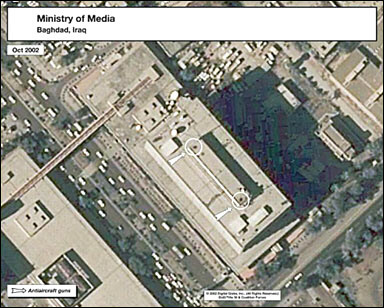
He said Powell used satellite pictures to try to show that decontamination trucks in front of an ammunition bunker were proof that Iraq was experimenting with chemical weapons there.
However, an earlier visit by UN inspectors had already determined that the trucks were firefighting vehicles.
"What Powell said simply wasn't true," Franck told the magazine.
He said US officials exaggurated the numbers of soldiers and equipment Iraq had at its disposal. A UN inspection of an air defence base showed the United States had over-estimated the number of planes there by five times.
Franck said US officials appear to have concentrated too much on satellite images, which could be interpreted different ways.
London and Washington have strongly denied claims that they manipulated any evidence.
By WARREN P. STROBEL
Knight Ridder Newspapers
Fri, Jun. 06, 2003
WASHINGTON - President Bush and his top aides made prewar claims about Iraq's weapons programs that weren't always backed up by available U.S. intelligence and painted a threatening picture that was far starker than what American spies knew, according to current and former intelligence officials and a review of available documents.
Bush and other White House officials also publicly cited evidence - particularly on Iraq's suspected nuclear-weapons program and ties with terrorists - that on closer examination turned out to be false or debatable.
Senior defense officials confirmed Friday that a report by the Pentagon's Defense Intelligence Agency last September expressed significant doubts about whether Saddam Hussein was producing and stockpiling chemical and biological weapons, as Bush, Defense Secretary Donald H. Rumsfeld and Secretary of State Colin Powell all claimed.
"There is no reliable information on whether Iraq is producing and stockpiling chemical weapons, or whether Iraq has - or will - establish its chemical warfare agent-production facilities," said portions of the report made available to Knight Ridder.
While Iraq had biological stockpiles, "the size of those stockpiles is uncertain and is subject to debate," said the classified report, titled "Iraq: Key Weapons Facilities - An Operational Support Study."
The DIA report and other developments illuminate a growing debate over the White House's use of intelligence on Iraq. So far that debate has revolved largely around allegations of pressure on professional analysts to shade intelligence estimates.
The new developments raise the possibility instead that some U.S. officials, deliberately or inadvertently, magnified what they were told by spy agencies, which had an incomplete picture of Iraq and few sources of their own to fill in the blanks.
The DIA report was completed just as the White House was launching a campaign last fall to make the case that Iraq's weapons of mass destruction and terrorist ties presented a grave danger that justified pre-emptive military action.
Vice Adm. Lowell Jacoby, the DIA's director, said after a private meeting with senators Friday that the report didn't mean that Iraq didn't have caches of chemical and biological weapons, only that his agency couldn't definitively pinpoint them.
"Some people higher up the food chain made the leap from suspicion to conviction," said a senior military official who is critical of how the intelligence was handled.
"I think they honestly believed that, based on how the Iraqis had always behaved in the past and not just because they wanted to scare the public into supporting the war," said the official, who spoke only on the condition of anonymity because of the classified information involved.
In a speech Oct. 7 in Cincinnati, Bush said the Iraqi regime "possesses and produces chemical and biological weapons." Powell told a television interviewer Sept. 8: "There is no doubt that (Saddam) has chemical weapons stocks."
The DIA report, whose existence was first reported by U.S. News & World Report magazine, illustrates how intelligence reports were much more equivocal. That reflected the shortfalls in U.S. spying capabilities in Iraq and the uncertain nature of the intelligence profession, officials have said.
"It's looking like in truth the Iraqi (weapons) program was gray. The Bush administration was trying to say it was black," said former CIA Iraq expert Kenneth Pollack, who's now at the Washington-based Brookings Institution, a research center.
All trademarks and copyrights on this page are owned by their respective companies.
printed from UN-Inspector: Iraq Evidence was "big bluff" on 2004-05-06 06:38:04