| Date: | Sunday June 08, @06:04PM |
|---|---|
| Author: | ewing2001 |
| Topic: | Bush |
| from the Guardian dept. | |
Dossier on Iraqi threat 'should not have been published'
Monday June 9, 2003 -The Guardian
David Blunkett yesterday became the most senior minister to admit publicly that Downing Street was wrong to publish the "dodgy dossier" on the military threat posed by Saddam Hussein, as both sides in the simmering Whitehall intelligence row moved to cool tempers.
With Tony Blair and the heads of the security services expected to be asked to give evidence to two Commons committees shortly, a closing of ranks can be expected in the face of renewed calls yesterday for a full public inquiry from the Conservative and Liberal Democrat leaderships and Labour rebels.
After weeks of sniping on both sides of the Atlantic about the quality of intelligence provided on Iraq's still-undiscovered weapons of mass destruction - and the political use made of it - the temperature rose again yesterday over fresh claims.
It was widely reported that Alastair Campbell, Mr Blair's communications director, had written to Sir Richard Dearlove, head of MI6, apologising that the dossier had "not met the required standard of accuracy" - it included plagiarised sections of a PhD thesis - when published in late January.
Last night No 10 confirmed that staff had been ticked off but not that Sir Richard had received a formal apology after his concerns, reported in Thursday's Guardian, were registered about the dossier. Contrary to yesterday's reports, the exchanges took place in February, before the war or recent recriminations.
No 10 has backed away from midweek talk of "rogue elements" in the intelligence community briefing against a Labour government. But yesterday it was forced to join forces with the Foreign Office and the security services to deny reports that both Sir Richard and his MI5 counterpart, Eliza Manningham-Buller, had threatened to resign. "Complete rubbish," said the Foreign Office.
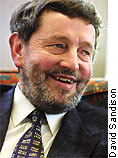
Mr Blunkett said on BBC1's Politics Show: "I think it would be better if we hadn't published that dossier because it was about the background to Iraq. It wasn't about the identification of weapons of mass destruction.
David Blunkett was born in Sheffield on 6th June 1947. He went to school in Sheffield until he was twelve years old and then attended the Royal Normal College (for the blind) at Rowton Castle in Shropshire.
After leaving school Mr Blunkett went back to Sheffield and worked for the Gas Board, studying economics, politics and economic history 'A' Levels in the evenings. He then won a place at Sheffield University to read Political Theory and Institutions and qualified with an Honours Degree.
Following University, Mr Blunkett worked as an industrial tutor at Barnsley College of Technology on Shop Steward, Health and Safety and National Certificate Courses teaching industrial relations and politics.
Mr Blunkett had joined the Labour Party at the age of sixteen and during his time at University became heavily involved with local political issues. In 1970, when a seat on Sheffield City Council became vacant, he agreed to stand as a candidate and won.
Over the next ten years he graduated quickly through chairmanship of the city's social services committee, chairman of the metropolitan authorities national committee, to become the leader of Sheffield City Council.
In 1983 Mr Blunkett was elected to the National Executive Committee of the Labour Party and a year later was elected as Chairman.
Then on 11th June 1987, David Blunkett became the Member of Parliament for Sheffield Brightside. Just over a year later he was appointed as the Local Government Frontbench Spokesman. He served in this post from November 1988 to July 1992, when he was elected to the Shadow Cabinet as Shadow Health Secretary.
In 1994 Mr Blunkett was appointed as Shadow Secretary of State for Education, and in 1995 this position was expanded to include employment as well as education.
The election in May 1997 saw the return of a Labour Government, and Mr Blunkett was appointed to the Cabinet in the post of Secretary of State for Education and Employment. He was appointed Home Secretary following the 2001 general election.
08 June 2003
"...This paper has, from the outset, consistently questioned the legality, morality and necessity of war with Iraq and has repeatedly called for firm evidence of Saddam's weapons of mass destruction. In this special report we examine the growing doubts over their existence...
Britain and America's case for war on Iraq - that Saddam Hussein's weapons of mass destruction posed an imminent threat to the world - came close to unravelling last week.
The claims of Tony Blair, George Bush and other senior British and American figures, powerfully made in numerous speeches and several dossiers, including the February presentation to the UN Security Council by Colin Powell, the US Secretary of State, were undermined by a stream of contradictory evidence. This included the leak of a classified document in the US, the public comments of former intelligence officials, endorsed in private by their still-serving colleagues - and the testimony of Hans Blix, outgoing head of the UN weapons inspectors.
Yesterday, the credibility of the President and Prime Minister was dealt a fresh blow. The New York Times revealed serious disagreements among scientists about the purpose of two trucks which both leaders have claimed as concrete evidence of the existence of WMD, a claim repeated by Mr Blair yesterday. According to the newspaper, growing confidence that the trucks were mobile biological laboratories has faltered as they come under closer and more expert examination.
As the two supposed laboratories threaten to join a lengthening list of WMD "discoveries" which later prove to be false alarms, the public confidence of the US and UK governments is giving way to behind-the-scenes recriminations about the quality of the intelligence provided to them and whether it was manipulated for political purposes.
Mr Blix said last week that he had been disappointed with the tip-offs provided by British and US intelligence while his inspectors were still in Iraq. They had been promised the best information available, he told the BBC. "Only in three of those cases did we find anything at all, and in none of these cases were there any weapons of mass destruction, and that shook me a bit, I must say.
"I thought - my God, if this is the best intelligence they have and we find nothing, what about the rest?"
Another former UN inspector, Bernd Birkicht, said he believed the CIA had made up intelligence on WMD to provide a legal basis for the war. Supposedly top-secret, high-quality intelligence had led the inspectors on an absurd wild goose chase, he complained.
"We received information about a site, giving the exact geographical co-ordinates, and when we got there we found nothing," said Mr Birkicht. "Nothing on the ground. Nothing under the ground. Just desert." He added that a "decontamination truck" in satellite photographs presented by Mr Powell to the Security Council was a fire engine.
Cees Wiebes, a leading Dutch expert who spoke to senior intelligence officials on both sides of the Atlantic before the war, said many of them told him the WMD evidence was "very, very poor". Even worse damage was done by the publication last week of parts of a classified report in September by the Defence Intelligence Agency in the US, which said there was "no reliable evidence" to prove that Saddam Hussein had developed chemical weapons.
The same month the US Defence Secretary, Donald Rumsfeld, was saying Iraq had "amassed large, clandestine stockpiles of chemical weapons, including VX, sarin and mustard gas". The DIA insisted the report had been quoted out of context, and said it still believed there were WMD to be discovered in Iraq.
But to say that there is disquiet among the intelligence community on both sides of the Atlantic is a vast understatement. Almost every day brings fresh soundings from disgruntled officials venting their opinions. Because of the sensitive nature of their work, such officials voice their concerns anonymously, allowing ministers such as John Reid to claim they are "rogue elements". But some academics and former officials who still have close ties to the intelligence community have spoken on the record, detailing what they consider a disturbing politicisation of intelligence analysis.
Greg Thielmann is a former director of the Strategic, Proliferation and Military Issues office in the US State Department's bureau of intelligence and research. His office was privy to classified intelligence gathered by the CIA and other agencies about Iraq's chemical, biological and nuclear programmes. He said that the British and US governments would essentially be sharing the same intelligence "product" and making their own assessments of it. From what he has seen he is adamant that both skewed the analysis to suit their political needs.
To show that Saddam was a threat to the US, it would have needed to be shown that he had either developed WMD or had developed close ties with a terror group such as al-Qa'ida, said Mr Thielmann. Neither was proved.
Of Tony Blair's claims that Saddam presented an imminent threat, he believed the Prime Minister had been selective of the material provided to him by the Joint Intelligence Committee (JIC), the top intelligence clearing body. Well-placed British sources are adamant that JIC caveats about intelligence provided by MI6 and GCHQ were pushed aside by Mr Blair at the behest of his closest aide, Alastair Campbell.
One of Britain's leading experts, Dr Richard Aldrich, says as much as 70 per cent of MI6's intelligence comes from the US. Some of this comes from Israel's Mossad, which has close links with the CIA. "I think few people realise how much of our intelligence comes from the US," he added..."
June 8
"...A top aide to Prime Minister Tony Blair wrote to the head of Britain's intelligence service earlier this spring conceding that the government's presentation of a report on Iraqi arms was mishandled and promising that "far greater care" would be taken with files in the future so as not to discredit the spy agency's work, a British newspaper said today.
The government admission that Alastair Campbell, Mr. Blair's director of communications, had written a letter of explanation to Sir Richard Dearlove, chief of the Secret Intelligence Service, known as MI6, came as the use of intelligence findings to muster support for the war on Iraq has increasingly come under questioning.
The apologetic letter was reported today by The Sunday Telegraph and confirmed by a Downing Street spokesman. He said that Mr. Campbell had told intelligence chiefs that procedures for handling information would be tightened and that "far greater care would be taken in dealing with anything that might impact on their reputation or their work."
The report, "Iraq: Its Infrastructure of Concealment, Deception and Intimidation," was made public in February as Mr. Blair tried to persuade the dubious British public of the need to forcefully disarm Saddam Hussein.
It is now referred to in the British news media as the "dodgy dossier" because of evidence that part of it was downloaded from the Internet — complete with typographical errors — from an American student's thesis that relied on 12-year-old public information...
... Tam Dalyell, a Labor parliamentarian who is the longest-serving member of the House of Commons and a persistent critic of Mr. Blair and the war, said in a statement today: "The implication of what Campbell said is that Britain went to war against Iraq on the basis of carelessness. I do not see what other conclusion can be drawn."
U.S. Says Iraq's Weapons Will Be Found
Jun 9, 2:21 AM EDT
"...The discovery of two Iraqi truck trailers, equipped with fermenters, is the strongest U.S. evidence to date that Iraq had a biological weapons program; no actual weapons have been found.
All this has raised questions about whether the intelligence that helped lead to the war was inaccurate or overplayed to generate support for an invasion.
The director of the Defense Intelligence Agency, Vice Adm. Lowell Jacoby, acknowledged last week that he had no hard evidence of Iraqi chemical weapons last fall but did believe Iraq had a program to produce them...
...Sen. Carl Levin of Michigan, top Democrat on the Senate Armed Services Committee, said he wants a full congressional investigation. "I think that the nation's credibility is on the line, as well as (Bush's)," he said..."
All trademarks and copyrights on this page are owned by their respective companies.
printed from British Minister: "Dossier on Iraqi threat 'should not have been published' " on 2004-04-30 11:24:50