Kelly took also part in all trilateral visits to the former Soviet Union, Russia, the US and the UK. He was Senior Advisor on Biological Weapons to UNSCOM from 1994-99, and led and participated
in many inspections in Iraq from 1991-98.
From 1984-1992 Kelly was Head of Microbiology at the Chemical and Biological Defence Establishment, Porton Down.
Porton Down, controversial for their Chemical Warfare Experimental Stations from the 20s to the 50s, was also able to obtain the Anthrax Spores, which had been used in the October 2001 attacks.
Porton Down, directly, and the CIA, indirectly, received their samples of the particular anthrax spores used in the attacks from the US Army Medical Research Institute of Infections Diseases at Fort Detrick, about 50 miles north of Washington.
Since the First World War, the Chemical and Biological Defence Establishment at Porton Down carried out experiments on volunteers to understand better the effects of chemical agents that might be used against British troops in warfare and improve protective measures.
In the 90s, Porton Downs cooperation with the British Government became stronger again and ended basically in a merger:
By 1991 the Chemical Defence Establishment of Porton Down became the Chemical and Biological Defence Establishment and was one of the six new Defence Support Agencies. In 1995, the Establishment became part of the Defence Evaluation and Research Agency (DERA), an executive agency of MOD evolved in 1994 from proposals of the “Front Line First” Defence Cost Studies.
In 2001, DERA split into two organisations: QinetiQ, a private company, and DSTL (Defence Science and Technology Laboratory), which remains an agency of MOD. Porton Down is now known as DSTL, Porton Down.
Today, Dstl delivers defence research, specialist technical services and the ability to track global technological developments.
In July 2002, the Carlyle Group took a 34% stake in QinetiQ.
Update:
GFP was obviously right. Kelly didn't make much sense as a BBC-whistleblower:
MoD official denies being dossier mole
Matthew Tempest, political correspondent
Guardian -Tuesday July 15, 2003
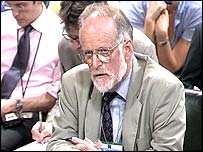
The Ministry of Defence official fingered by his own bosses as the origin of the BBC's controversial story doubting the government's estimation of Iraq's weapons programme today denied he was the main source of the story.
Dr David Kelly, a former weapons inspector and MoD official, said he met BBC reporter Andrew Gilligan three times, but most recently only to discuss the journalist's own trip to Iraq.
And he said broadly agreed with the September dossier outlining the case against Saddam Hussein.
Giving evidence under hostile questioning from the foreign affairs select committee, Dr Kelly confirmed that he met Mr Gilligan and that the subject of Downing Street communications chief Alastair Campbell did come up. However, he said he did not recognise his words in Mr Gilligan's report for BBC Radio 4's Today programme.
