| Date: | Tuesday August 19, @12:43PM |
|---|---|
| Author: | ewing2001 |
| Topic: | News |
| from the Guardian dept. | |
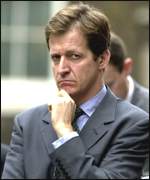
Photo: Alastair Campbell, who received a copy of email by adviser Jonathan Powell
One of the prime minister's closest advisers issued a private warning that it would be wrong for Tony Blair to claim Iraq's banned weapons programme showed Saddam Hussein presented an "imminent threat" to the west or even his Arab neighbours.
In a message that goes to the heart of the government's case for war, the Downing Street chief of staff, Jonathan Powell, raised serious doubts about the nature of September's Downing Street dossier on Iraq's banned weapons.
"We will need to make it clear in launching the document that we do not claim that we have evidence that he is an imminent threat," Mr Powell wrote on September 17, a week before the document was finally published.
His remarks urging caution contrasted with the chilling language used by Mr Blair in a passionate speech in the Commons as he launched the dossier a week later.
He described Iraq's prog-ramme for weapons of mass destruction as "active, detailed, and growing ... It is up and running now".
Mr Powell's private concerns came in the form of an email which was copied to Alastair Campbell, Downing Street's director of communications, and Sir David Manning, Mr Blair's foreign policy adviser.
The fact the three closest men to the prime minister knew of this information strongly suggests Mr Blair would have been aware.
Downing Street also faced severe embarrassment yesterday when the Hutton inquiry was told the prime minister's official spokesman in an email had described the government's battles with the BBC as a "game of chicken".
The email revealed how senior Downing Street officials - and on occasion Mr Blair himself - became intimately involved in the events which led to the death of the government scientist David Kelly.
UK Officials Wanted to Gag Expert on Iraq Dossier
Reuters -Wed, Aug 20, 2003
LONDON (Reuters) - Government documents released on Wednesday show top British officials tried to stop a scientist airing doubts on a Iraqi weapons dossier on which Prime Minister Tony Blair based the case for war.
The documents emerged in an inquiry into the suicide of
weapons expert David Kelly, sucked into the heart of a furious
row between Blair's government and the BBC over whether
intelligence was "sexed up" for political ends.
Kelly was outed as the source for a BBC journalist's report
accusing Blair's inner circle of hyping evidence about Iraq's
weapons capability to win over a skeptical public.
An official note, written on July 14, the day before Kelly
was due to testify to a parliamentary committee, made clear
that Kelly would be told to keep his views to himself.
It said the respected scientist was due to be briefed later
that day by the deputy chief of defense intelligence (DCDI)
about his appearances in front of the foreign affairs committee
and intelligence and security committee on July 15 and 16.
"DCDI is to brief Dr Kelly this afternoon for his
appearance tomorrow before the FAC and ISC and will strongly
recommend that Kelly is not drawn on his assessment of the
dossier," read the note, which was shown to the inquiry.
Separate documents revealed that the top civil servant at
Britain's Ministry of Defense had said at a meeting in Blair's
office one week earlier that some of Kelly's views would be
awkward for the government.
"If he was summoned to give evidence, some of it might be
uncomfortable on specifics such as the likelihood of there
being weapons systems ready for use within 45 minutes," the
defense civil servant said at the meeting.
Blair okayed Kelly Outing
Guardian -August 20
Tony Blair agreed the strategy that led to the eventual "outing" of David Kelly as Andrew Gilligan's source, the Ministry of Defence's top civil servant told the Hutton inquiry today.
Sir Kevin Tebbit, the MoD's permanent under-secretary, described how it was conveyed to him that the prime minister wanted "something done about this individual coming forward"
BBC -Thursday, 21 August, 2003
Dr David Kelly told a UK diplomat he would probably be "found dead in the woods" if the UK invaded Iraq, the Hutton inquiry has heard.
David Broucher, the UK's permanent representative on the disarmament conference in Geneva, said the scientist made what at the time he regarded as a "throwaway remark" in February.
It was only when he heard that Dr Kelly had been found dead in Oxfordshire woodland last month that Mr Broucher thought the comment might be more significant.
Mr Broucher said the remark was made after Dr Kelly had explained to him that he had assured senior Iraqi officials that if they cooperated with United Nations weapons inspections they would have nothing to fear.
"The implication was that if the invasion went ahead, that would make him a liar and he would have betrayed his contacts, some of whom might be killed as a direct result of his actions," he said.
"I asked him what would happen then. He replied, in a throwaway line, he would probably be found dead in the woods."
Kelly's talk of death in the woods
All trademarks and copyrights on this page are owned by their respective companies.
printed from UK Iraqgate- Intelligence knew: Iraq no threat on 2004-05-31 00:38:47