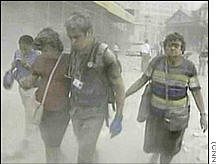
Speaking on the steps of City Hall, Clinton said she had sent a letter to President George W. Bush Tuesda asking for a thorough and expeditious accounting of what transpired in the White House after the attacks, including the names of officials who changed EPA information.
The letter, also signed by Sen. Joseph Lieberman (D-Conn.), asked the president to respond by Sept. 5.
"Maybe after the first couple of days nobody could know," Clinton said, referring to the EPA statements after Sept. 11. "But a week later? Two weeks later? Two months later? Six months later? Give me a break. They knew and they were going to tell us the truth and the White House told them not to tell us the truth.
"Now they should come to New York and face us," she said.
White House representatives have argued against the Inspector General's findings, stating that the choices made by the Bush administration were necessary for national security reasons.
In the letter to the president, Clinton also asked the Bush administration to implement a new testing program to ensure residents are no longer at risk of exposure to harmful toxins in the dust and air.
Rep. Jerrold Nadler (D-N.Y.) called on Mayor Michael Bloomberg to take a more active role in pressing the federal government for a proper cleanup of lower Manhattan homes, schools and businesses.
At the news conference, Madelyn Wils, chairwoman of Community Board 1, said much of the blame should also be placed on the administration of former Mayor Rudolph Giuliani for not responding to concerns of residents in lower Manhattan immediately after the attack.
While much of the city was focused on recovering victims from the debris, Wils said the health of residents and workers was largely ignored.
"Who was looking after the living?" Wils asked. "No one was looking after the living."
The explosion and collapse of the World Trade Center (WTC) was a catastrophic event that produced an aerosol plume impacting many workers, residents, and commuters during the first few days after 11 September 2001. Three bulk samples of the total settled dust and smoke were collected at weather-protected locations east of the WTC on 16 and 17 September 2001; these samples are representative of the generated material that settled immediately after the explosion and fire and the concurrent collapse of the two structures. We analyzed each sample, not differentiated by particle size, for inorganic and organic composition.
In the inorganic analyses, we identified metals, radionuclides, ionic species, asbestos, and inorganic species. In the organic analyses, we identified polycyclic aromatic hydrocarbons (PAHs), polychlorinated biphenyls, polychlorinated dibenzodioxins, polychlorinated dibenzofurans, pesticides, phthalate esters, brominated diphenyl ethers, and other hydrocarbons.
Each sample had a basic pH. Asbestos levels ranged from 0.8% to 3.0% of the mass, the PAHs were > 0.1% of the mass, and lead ranged from 101 to 625 µg/g. The content and distribution of material was indicative of a complex mixture of building debris and combustion products in the resulting plume.
These three samples were composed primarily of construction materials, soot, paint (leaded and unleaded), and glass fibers (mineral wool and fiberglass). Levels of hydrocarbons indicated unburned or partially burned jet fuel, plastic, cellulose, and other materials that were ignited by the fire.
In morphologic analyses we found that a majority of the mass was fibrous and composed of many types of fibers (e.g., mineral wool, fiberglass, asbestos, wood, paper, and cotton). The particles were separated into size classifications by gravimetric and aerodynamic methods. Material < 2.5 µm in aerodynamic diameter was 0.88-1.98% of the total mass. The largest mass concentrations were > 53 µm in diameter.
other hydrocarbons
http://www.atsdr.cdc.gov/tfacts69.html
Polycyclic aromatic hydrocarbons (PAHs)
...are a group of over 100 different chemicals that are formed during the incomplete burning of coal, oil and gas, garbage, or other organic substances like tobacco or charbroiled meat.
http://www.atsdr.cdc.gov/tfacts17.html
Polychlorinated Biphenyls (PCBs)
...mixture of individual chemicals which are no longer produced in the United States ,
but are still found in the environment
Polychlorinated biphenyls are mixtures of up to 209 individual chlorinated compounds (known as congeners). There are no known natural sources of PCBs. PCBs are either oily liquids or solids that are colorless to light yellow. Some PCBs can exist as a vapor in air. PCBs have no known smell or taste. Many commercial PCB mixtures are known in the U.S. by the trade name Aroclor.
PCBs have been used as coolants and lubricants in transformers, capacitors, and other electrical equipment because they don't burn easily and are good insulators. The manufacture of PCBs was stopped in the U.S. in 1977 because of evidence they build up in the environment and can cause harmful health effects.
http://www.ec.gc.ca/substances/ese/eng/psap/PSL1_dioxins.cfm
Polychlorinated Dibenzodioxins and Polychlorinated Dibenzofurans
...compounds with a strong affinity for sediments and a high potential for accumulating in biological tissues. They have been found in all compartments of the ecosystem, including: air, water, soil, sediments, animals and foods.
Dioxins and furans enter the environment as complex mixtures from four major sources: commercial chemicals (eg. pentachlorophenol); incineration; pulp and paper mills that use chlorine bleaching; and both accidental fires and spills involving polychlorinated biphenyls (PCBs, which contain principally furan contaminants).
http://www.epa.gov/pesticides/
Pesticides
....Though often misunderstood to refer only to insecticides, the term pesticide also applies to herbicides, fungicides, and various other substances used to control pests.
Under United States law, a pesticide is also any substance or mixture of substances intended for use as a plant regulator, defoliant, or desiccant.
http://www.phthalates.org/whatare/index.asp
phthalate esters
...Phthalates are a family of chemical compounds that have been developed in the last century. Although the various kinds of phthalates (pronounced THAL-aytes) in use today have a certain similarity of appearance and structure, phthalates perform many different tasks. There is no way to complete the sentence "phthalates are…"
Phthalates look like vegetable oil. They have little or no smell. Consumers never use them alone. They are incorporated into products that consumers use every day. About 80 percent of all the phthalates manufactured today are used as "plasticizers." That is, they make plastics flexible without sacrificing strength or durability.
Their chief use is as plasticizers in vinyl, a very familiar, popular and versatile form of plastic. Vinyl (also known as PVC, or polyvinyl chloride) is ordinarily hard. But when certain phthalates are added into the vinyl manufacturing process they act as a lubricant among the long vinyl molecules, permitting them to slip and slide against one another.
http://www.injuryboard.com/view.cfm/Topic=177
brominated diphenyl ethers
... Brominated Diphenyl Ethers (BDEs) are added to polyurethane and other products as fire retardants. BDEs do not readily degrade in the environment. Excessive levels of BDEs are being found in treated sludge spread on farmland as a fertilizer. The substance is also increasingly appearing in fish.
BDEs are popular with manufacturers because of their ability to suppress fire (used by firemen???).
http://www.howe.k12.ok.us/~jimaskew/calkane.htm
hydrocarbons
...substances composed of only hydrogen and carbon.
An underground hydrocarbon trap Hydrocarbons usually occur in specific types of rocks, principally shales. Organic remains gradually rot, and are buried and compressed by new sediments. Heat and pressure may change the carbon from the rocks into hydrocarbons. Oil tends to form in rocks whose carbon comes largely from marine plants and animals. Gas tends to form in deposits which contain carbon largely from land plants.
EPA Inspector's General Report
"...Hazardous material removed from the site included an estimated 236 batteries, 802 containers, and 3,049 cylinders that had potential to cause environmental and human health damage. Further, approximately 639,465 gallons of fuel oil and/or oily water mixture were pumped from basements, manholes, trenches, and underground storage tanks. A NYCDDC official told us that EPA s response was phenomenal in his opinion and that EPA s response crews were on top of every issue....
10-03-01... Data Confirms No Significant Public Health Risks; Rescue Crews and Nearby Residents Should Take Appropriate Precautions. . . (press release sub-heading)...
...For several pollutants of concern, sampling did not begin until September 16, and in many cases the results were not known until after the September 18 press release was issued. EPA was not able to obtain samples and monitor air due to difficulties in access and security, power supply sources, equipment availability, and analytical capacity. As a result, data available before September 18 for making conclusions about air quality for pollutants other than asbestos was limited...
Sep 16 press release:
Seven debris and dust samples taken Thursday, showed levels of asbestos ranging from 2.1 percent to 3.3 percent. EPA views a 1 percent level of asbestos as the definition for asbestos-containing material. Debris samples collected outside buildings on cars and other surfaces contained small percentages of asbestors, [sic] ranging from 2.1 to 3.3 - slightly above the 1 percent trigger for defining asbestos material...
Recent Conclusions About WTC Air Quality
The only formal risk evaluation of the health effects from exposure to the outdoor air in Lower Manhattan following the WTC collapse was performed by EPA s Office of Research and Development.
This evaluation, still in draft form as of July 2003, concluded that, except for the rescue and cleanup workers at Ground Zero who were not wearing respirators, as well as unknown exposures to the public during the first few days, persons in the area were unlikely to suffer adverse heath effects from the outdoor air. The report also had a caveat for the conclusions drawn in the report relative to human health risks. The draft report stated:
This report should be viewed as the first phase of an ongoing analysis, and the conclusions and findings cited below should not be considered the final EPA judgment. At this point, the available data and analysis are still too preliminary to support reliable quantitative predictions of potential human health risks. We spoke to a number of experts in the field of environmental monitoring, including physicians, industrial hygienists, and researchers These experts generally agreed that the levels of airborne asbestos detected in the air outside the perimeter of Ground Zero in Lower Manhattan did not present a significant increase in long-term health risk to the public.
Appendix I lists the experts we interviewed during this evaluation. We noted that several health studies pointed to potential problems for firefighters, rescue workers, and other persons working within the confines of Ground Zero who did not wear respirators: " A study of firefighters with World Trade Center Cough concluded that intense, short-term exposure to materials generated during the collapse of the World Trade Center was associated with bronchial responsiveness and the development of cough. 5 " The preliminary results of a Mount Sinai School of Medicine study on workers directly involved in rescue and recovery found that 78 percent of those sampled had suffered lung ailments and 88 percent had experienced ear, nose, and throat problems in the months immediately following the attack.
Clinton and Nadler Seek Inquiry Into E.P.A. Response to Sept. 11
NY Times -August 27, 2003
Senator Hillary Rodham Clinton and Representative Jerrold L. Nadler called yesterday for a Congressional inquiry into the Environmental Protection Agency's response to the World Trade Center attack, saying that the agency and the White House had not told the truth about potential health hazards...
...Senator Clinton said she and Senator Joseph I. Lieberman of Connecticut had written to President Bush, asking for a "thorough and expeditious accounting of what transpired" among White House officials.
"I know a little bit about how White Houses work," she said. "I know somebody picked up a phone, somebody got on a computer, somebody sent an e-mail, somebody called for a meeting, somebody in that White House probably under instructions from somebody further up the chain told the E.P.A.: `Don't tell the people of New York the truth.' And I want to know who that is."
A spokeswoman for the White House Council on Environmental Quality, which was named in the inspector general's report, declined to comment on Senator Clinton's demands. But the spokeswoman said the Bush administration had worked closely with federal agencies to make sure that New Yorkers received accurate information.
Marianne Horinko, the environmental agency's acting administrator, said that although White House officials were "involved in coordinating the data," they had not unduly influenced the agency's message. "This just seems to me to be an opportunity to take what was a horrible tragedy and once again exploit it for political gain," she said.
Several City Council members also called yesterday for a Council hearing into whether city agencies had not given residents adequate warning about health dangers, and Representative Nadler urged Mayor Michael R. Bloomberg to ask the federal agency to conduct "a proper cleanup" of contaminated areas.
Mayor Bloomberg, who was traveling in Israel yesterday, seemed to play down the risks of contamination at a news conference on Sunday, but he added that he would ask city officials to review the inspector general's report. "If you lived down there, clean your apartment," the mayor said. "I think most people have done that, and hopefully today the air is as safe as you could possibly have it, living in a big city."
MSNBC - Sept. 8 issue
‘We Were Not Told to Lie’ About 9/11 and Health
After stepping down this summer as the head of the EPA, the embattled Christine Todd Whitman is once again in the hot seat. This time it’s over her role in the downplaying of health hazards for New York City residents after 9/11. A report by the EPA inspector general says that Whitman assured the public that the air was safe before testing was conclusive. She’s also under fire for allowing EPA statements to be filtered through the White House and screened by the Council on Environmental Quality, which is chaired by James Connaughton, a lawyer who formerly represented the asbestos industry.
THE LONG-TERM effects of inhaling contaminated air is unknown. But New York Rep. Jerrold Nadler accuses the administration of covering up a potential health danger in order to get the economy up and running. “Many people will die early because of this,” says Nadler.
In her first interview since the release of the report, Whitman tells NEWSWEEK that she did not object when the White House edited out cautionary notes by EPA scientists. “We didn’t want to scare people,” she said, explaining that spikes in asbestos readings tended to return quickly to acceptable levels. She believes that much of the data were open to interpretation, and that the public wasn’t harmed by the White House’s decision to adopt the more reassuring analysis. But New York Sen. Hillary Clinton is calling for an investigation, saying she knows how the White House works and that somebody surely leaned on the EPA to lie. “We were not told to lie,” says Whitman.
Firefighters and other rescue workers suffering health problems continue to blame the EPA for failing to make them aware of the risks. The EPA advised wearing protective clothing and masks, Whitman says, but many working on the site rejected the gear as too cumbersome. “We couldn’t force them to do it,” says Whitman. In addition, residents returning to the area say they weren’t told to have their homes professionally cleaned. “Maybe there was one press release where we didn’t say that, but then we said it over and over,” says Whitman.
EPA’s former ombudsman said soon after 9/11 that Whitman had a conflict of interest because of her husband’s connection to Citigroup, which owns Travelers Insurance. By pronouncing lower Manhattan safe, critics say, Whitman saved the insurance giant millions in cleanup costs. Whitman was cleared of the conflict by the EPA inspector general. “There’s no way in hell—excuse my language—that I would ever, ever play games with this kind of information.”
Whitman denies WTC Air Cover up
NY Post -
September 1, 2003
Former New Jersey Gov. Christie
Whitman, who
headed the Environmental Protection Agency in the aftermath of 9/11,
has
denied she was told to lie and downplay the concern over contaminated
air near
Ground Zero.
Whitman has come under fire from Sen. Hillary Rodham Clinton (D-N.Y.)
and
Rep. Jerrold Nadler (D-Manhattan), who accuse her of allowing EPA
statements to
be filtered through White House channels. In her first interview since
she
stepped down from her post this summer, she told Newsweek magazine, "We
were not
told to lie."
EDanger In The Dust: EPA assured public before actual testing
Newsday -August 28, 2003
...The EPA's own publications and Web site show the first air samples collected for fine particulate analysis were taken around Ground Zero 10 to 15 days after the attack, and results weren't known until early October. Coarse particulate samples weren't collected until early October, after lower Manhattan streets had been cleaned and the bulk of the debris outside the immediate World Trade Center site had been removed.
Yet on Sept. 13, 2001, the EPA issued the following statement: "Monitoring and sampling conducted on Tuesday and Wednesday [Sept. 11 and 12]have been very reassuring about potential exposure of rescue crews and the public to environmental contaminants ... the general public should be very reassured by initial sampling."
The EPA database shows it either collected or received from other federal, state and city agencies 66,000 dust and air samples between Sept. 11 and November 13, 2001. Almost none was available when the EPA pronounced the air safe to breathe.
...According to an internal EPA report released Friday, the EPA was directed by the White House in the days after Sept. 11 to amend its press releases by adding reassuring statements and removing cautionary ones. On Sept. 16, the day before the stock market reopened, the EPA insisted, "Our tests show that it is safe for New Yorkers to go back to work in New York's financial district." Workers and residents shortly began returning to their downtown offices and homes.
...The key player in the White House campaign to soften concerns about New York's air was, according to Washington sources, CEQ director James Connaughton. He had worked for the law firm Sidley Austin Brown & Wood in its environmental practice group, until shortly before the attack, and had represented mining companies accused of pollution offenses. Calls to the White House for comment were not returned, nor were interview requests to the National Security Council...
OFFICE WORKERS
Dr. Steven Levin at the Mount Sinai Hospital is leading a team studying 6,100 workers in offices and businesses below Canal Street on Sept. 11, 2001. Nearly all have symptoms of respiratory illnesses similar to asthma: periodic gasping for air, a choking sensation and unusual sensitivity to airborne irritants. Levin is convinced they have a type of "occupational asthma" called Reactive Airways Disease Syndrome.
GROUND ZERO COPS
Dr. Walfredo Lyon and his Downstate Medical Center team in Brooklyn found RADS in a study of 82 New York City police officers who worked around Ground Zero during the fall of 2001. "Most are still sick," he said. "And that's what they have - RADS."
FIREFIGHTER COUGH
A study conducted by several medical schools and the city fire department found 332 firefighters at Ground Zero suffered respiratory problems, including RADS. The researchers dubbed the ailment World Trade Center Cough. Most of the firefighters are on permanent disability.
SMALLER BABIES
Women who were pregnant on Sept. 11 and lived or worked around Ground Zero were twice as likely to deliver a baby smaller than normal among New Yorkers of similar racial and economic backgrounds. Dr. Philip Landrigan and his colleagues at Mount Sinai School of Medicine examined 187 women and their newborns, comparing them with 3,000 mother/baby combinations from uptown Manhattan. They found the birth weight for the Ground Zero babies was an ounce or more below normal.
ASTHMA INCREASE
Anecdotally, physicians in Brooklyn and lower Manhattan report a sharp uptick in adult-onset asthma diagnoses since Sept. 11. Still pending are the results of a joint NYU/New York State Department of Health survey of 10,000 lower Manhattan residents, conducted by Dr. Joan Reibman of NYU. Results have been tabulated, but they are not ready for release, Reibman said.
James Connaughton is term member of the Council on Foreign Relations since 1994, he is a graduate of Yale University and received a law degree from Northwestern University. He has served for the last seven years as one of the lead negotiators on the U.S. Technical Advisory Group to the International Standards Organization Technical Committee 207. (Source: Morris K. Udall Foundation)
Dan Halper about "The EPA as lead agency" (3c iii, 2002 )
iv. Christine Todd Whitman s initial comments on air quality The White Paper of Manhattan congressman Jerrold Nadler quotes from a September 18 th , 2001 press release from the Environmental Protection Agency. Environmental Protection Agency Administrator Christine Todd Whitman was quoted as saying that the New York air was safe to breathe and that New Yorkers, [N]eed not be concerned about environmental issues as they return to their homes and workplaces. 15 Nadler s White Paper goes on to point out that Whitman made this statement prior to receiving the results of a single test of outdoor air.
b iii. Fortunate horizontal agency parallelism Fortunately, not all Federal agencies were answering to EPA administrator Christine Todd Whitman, nor were all employees of the EPA immediately willing to participate in a conspiracy of silence. The most well known study of outdoor air quality which conflicts with the EPA s data was done by University of California at Davis scientist Thomas Cahill under contract with the United States Department of Energy. Dr. Cahill found an unprecedented level of ultra-fine particulates which [O]ut did even the worst pollution from the Kuwait oil fields fires.
Please check out also Dan Halper'sWorld Trade Center Toxic Disaster -- Final Clinic Report, who helped assisting Joel Kupferman and the New York Environmental Law and Justice Project