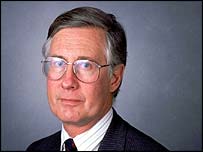
The embarrassed WTO denied that he was a security threat and admitted that an error may have been made. "We have never heard of him, but we question whether he is a bona fide journalist," said a spokesman. Mr Meacher was furious: "Let's just say that my opinion of the WTO is not high right now."
September 11: After two years, cover-up begins to unravel
wsws.org
11 September 2003
Michael Meacher, who until last June was a member of Blair’s cabinet and the most veteran minister within the Labour government, published an article in the British Guardian that presented a highly disturbing body of evidence indicating that significant sections within the US state apparatus anticipated some form of terrorist attack, yet failed to take action to stop it [see: “British official charges US ‘stood down’ on 9/11”].
The material strongly suggests that, while they may not have anticipated carnage on the scale of the World Trade Center, these elements welcomed an act of terrorism that they believed would provide justification for setting into motion a far-reaching and long-planned agenda of global military aggression. Meacher raised the question of whether US security operations could “have been deliberately stood down on September 11. If so why, and on whose authority?”
Meanwhile, in the US itself the Bush administration has conducted a systematic cover-up of information concerning the September 11 attacks. It routinely invokes “national security” to prevent the dissemination to the American people of information that is obviously already in the hands of those whom it is supposedly combating in its “global war on terrorism.”
Censoring the Saudi connection
What the administration chose to censor from the report issued in July by the joint congressional committee investigation into intelligence failures preceding the September 11 attacks sheds some light on the nature and motives of this government’s cover-up.
A full 28-page chapter of the report was reduced to page after page of blank lines, classified on the pretext of “national security.” The government’s aim was to suppress information concerning the complicity of the Saudi government in the suicide attacks. Fifteen of the nineteen people identified as the hijackers were Saudi citizens.
Following the release of the report in July, Sen. Bob Graham, ranking Democrat and former chairman on the Senate Select Intelligence Committee which led the investigation, indicated that the censored material dealt with active assistance that Saudi officials rendered to the hijackers and evidence that they were acting with the knowledge of the ruling monarchy.
“High officials in this government, who I assume were not just rogue officials acting on their own, made substantial contributions to the support and well-being of two of these terrorists and facilitated their ability to plan, practice and execute the tragedy of September 11,” Graham said in a television interview.
Graham was referring to the extraordinary case of Nawaf al-Hazami and Khalid al-Mihdhar, two Saudis who were identified as hijackers of American Airlines Flight 77, which was crashed into the Pentagon. Both men were known Al Qaeda operatives and tracked by US intelligence since 1999. They flew under their own names to the US after attending a meeting of the Islamist terrorist group in Malaysia, where they were under CIA surveillance. The CIA knew they had entered the country, yet nothing was done to inform any law enforcement or immigration officials. When one of the men’s visas expired, the State Department quickly renewed it.
According to the congressional report, once in Los Angeles, they were met by Omar al-Bayoumi, who is described as someone who “had access to seemingly unlimited funding from Saudi Arabia” and was believed by the FBI to “be an intelligence officer for Saudi Arabia or another foreign power.”
Bayoumi went to collect the pair directly from a closed-door meeting in the Saudi consulate and then took them to San Diego. There they moved in with a man who was the FBI’s chief informant in the city on Islamist groups. Thus, these two known terrorist operatives were in contact with the CIA, Saudi intelligence and the FBI in the months leading up to the attacks.
The joint congressional committee was denied permission to interview the FBI informant.
Further indications of the connections of both the Saudi ruling family and the Pakistani military and intelligence apparatus with the September 11 hijackers have surfaced with the publication of the book “Why America Slept,” by Gerald Posner. That Posner’s thesis is taken seriously within ruling circles was made clear by a two-page review published in the September 8 issue of Time magazine.
What Zubaydah told the CIA
Posner cited details from the US interrogation—using torture and drugs—of Abu Zubaydah, a senior aide to Osama bin Laden, who was captured in Pakistan in March 2002.
Basing himself on two government sources familiar with the interrogation, Posner reports that Zubaydah provided his captors with “the Rosetta stone of 9/11... the details of what [he] claimed was his ‘work’ for senior Saudi and Pakistani officials.”
He reports that CIA agents, in an attempt to intimidate Zubaydah, took the captured Al Qaeda operative to two Arab interrogators who posed as Saudi intelligence agents. When confronted with what he thought were Saudi police “his reaction was not fear, but utter relief,” Posner writes. He immediately gave them phone numbers for a senior member of the Saudi royal family—Prince Ahmed bin Salmman Abdul Aziz—and told them he would “tell you what to do.”
Zubaydah described a series of meetings dating back from the early 1990s between himself and bin Laden, on the one hand; and, on the other, senior Saudi and Pakistani intelligence officials, including Prince Turki al-Faisl bin Abul Aziz, the long-time Saudi intelligence chief...
Guerrilla of the week
Guerrillanews -September 8, 2003
On the eve of the second anniversary of 9/11, the once mighty Bush administration appears as weak as it ever has. Last night, the president offered a limp attempt to put a positive spin on the prospects for stability in post-invasion Iraq, and an even less effective appeal to our former allies to come to our aid. Iraq is an albatross that is turning into a noose.
Even more troubling for Bush is the increasing focus on his old friends the Saudi royal family and their ties to anti-American terror and specifically 9/11. An article in the October issue of Vanity Fair details the astonishing story of how the 'highest levels of the U.S. government' OKed secret flights for a shadowy group of 140 Saudi nationals, including bin Laden family members, to flee the U.S. on September 13, when civilian aircraft were still grounded and thousands of law enforcement and intelligence agents were scouring the country for leads into the attacks. And a new book by Gerald Posner entitled "Why American Slept," makes startling new allegations about some of the key 9/11 players' connections to the Saudi Kingdom. Posner writes the Saudis "effectively had (bin Laden) on their payroll since the start of the decade" - a charge made more than a year ago by GNN's friend Greg Palast. What is significant is these allegations are no longer being ignored by the mainstream media here in the U.S. - the evidence is just too overwhelming.
But probably the most hotly debated recent article was by this week's guerrilla, former British Labour MP Michael Meacher. Best known for his stands against genetically modified foods and for sustainable development, the former environment minister published a piece in the London Guardian that came within a hair's length of accusing the Bush administration of direct foreknowledge of the 9/11 attacks.
For a popular politician from the same party as the U.S.'s top ally in the so-called War on Terror to publicly, and so convincingly, dissect the Bush administration's motives and actions marks an important turning point in global attitudes towards the Bush administration.
This War on Terrorism is Bogus, by Michael Meacher
The 9/11 attacks gave the U.S. an ideal pretext to use force to secure its global domination
Massive attention has now been given - and rightly so - to the reasons why Britain went to war against Iraq. But far too little attention has focused on why the U.S. went to war, and that throws light on British motives too. The conventional explanation is that after the Twin Towers were hit, retaliation against al-Qaida bases in Afghanistan was a natural first step in launching a global war against terrorism. Then, because Saddam Hussein was alleged by the US and UK governments to retain weapons of mass destruction, the war could be extended to Iraq as well. However this theory does not fit all the facts. The truth may be a great deal murkier.
We now know that a blueprint for the creation of a global Pax Americana was drawn up for Dick Cheney (now vice-president), Donald Rumsfeld (defense secretary), Paul Wolfowitz (Rumsfeld's deputy), Jeb Bush (George Bush's younger brother) and Lewis Libby (Cheney's chief of staff). The document, entitled Rebuilding America's Defenses, was written in September 2000 by the neoconservative think tank, Project for the New American Century (PNAC).
The plan shows Bush's cabinet intended to take military control of the Gulf region whether or not Saddam Hussein was in power. It says "while the unresolved conflict with Iraq provides the immediate justification, the need for a substantial American force presence in the Gulf transcends the issue of the regime of Saddam Hussein."
The PNAC blueprint supports an earlier document attributed to Wolfowitz and Libby which said the U.S. must "discourage advanced industrial nations from challenging our leadership or even aspiring to a larger regional or global role". It refers to key allies such as the UK as "the most effective and efficient means of exercising American global leadership". It describes peacekeeping missions as "demanding American political leadership rather than that of the UN". It says "even should Saddam pass from the scene", U.S. bases in Saudi Arabia and Kuwait will remain permanently... as "Iran may well prove as large a threat to U.S. interests as Iraq has". It spotlights China for "regime change", saying "it is time to increase the presence of American forces in SE Asia".
The document also calls for the creation of "U.S. space forces" to dominate space, and the total control of cyberspace to prevent "enemies" using the internet against the U.S. It also hints that the U.S. may consider developing biological weapons "that can target specific genotypes [and] may transform biological warfare from the realm of terror to a politically useful tool".
Finally - written a year before 9/11 - it pinpoints North Korea, Syria and Iran as dangerous regimes, and says their existence justifies the creation of a "worldwide command and control system". This is a blueprint for U.S. world domination. But before it is dismissed as an agenda for rightwing fantasists, it is clear it provides a much better explanation of what actually happened before, during and after 9/11 than the global war on terrorism thesis. This can be seen in several ways.
First, it is clear the U.S. authorities did little or nothing to pre-empt the events of 9/11. It is known that at least 11 countries provided advance warning to the U.S. of the 9/11 attacks. Two senior Mossad experts were sent to Washington in August 2001 to alert the CIA and FBI to a cell of 200 terrorists said to be preparing a big operation (Daily Telegraph, September 16 2001). The list they provided included the names of four of the 9/11 hijackers, none of whom was arrested.
It had been known as early as 1996 that there were plans to hit Washington targets with airplanes. Then in 1999 a U.S. national intelligence council report noted that "al-Qaida suicide bombers could crash-land an aircraft packed with high explosives into the Pentagon, the headquarters of the CIA, or the White House".
Fifteen of the 9/11 hijackers obtained their visas in Saudi Arabia. Michael Springman, the former head of the American visa bureau in Jeddah, has stated that since 1987 the CIA had been illicitly issuing visas to unqualified applicants from the Middle East and bringing them to the US for training in terrorism for the Afghan war in collaboration with Bin Laden (BBC, November 6 2001). It seems this operation continued after the Afghan war for other purposes. It is also reported that five of the hijackers received training at secure U.S. military installations in the 1990s (Newsweek, September 15 2001).
Instructive leads prior to 9/11 were not followed up. French Moroccan flight student Zacarias Moussaoui (now thought to be the 20th hijacker) was arrested in August 2001 after an instructor reported he showed a suspicious interest in learning how to steer large airliners. When U.S. agents learned from French intelligence he had radical Islamist ties, they sought a warrant to search his computer, which contained clues to the September 11 mission (Times, November 3 2001). But they were turned down by the FBI. One agent wrote, a month before 9/11, that Moussaoui might be planning to crash into the Twin Towers (Newsweek, May 20 2002).
All of this makes it all the more astonishing - on the war on terrorism perspective - that there was such slow reaction on September 11 itself. The first hijacking was suspected at not later than 8.20am, and the last hijacked aircraft crashed in Pennsylvania at 10.06am. Not a single fighter plane was scrambled to investigate from the U.S. Andrews Air Force base, just 10 miles from Washington DC, until after the third plane had hit the Pentagon at 9.38 am. Why not? There were standard FAA intercept procedures for hijacked aircraft before 9/11. Between September 2000 and June 2001 the U.S. military launched fighter aircraft on 67 occasions to chase suspicious aircraft (AP, August 13 2002). It is a U.S. legal requirement that once an aircraft has moved significantly off its flight plan, fighter planes are sent up to investigate.
Was this inaction simply the result of key people disregarding, or being ignorant of, the evidence? Or could U.S. air security operations have been deliberately stood down on September 11? If so, why, and on whose authority? The former U.S. federal crimes prosecutor, John Loftus, has said: "The information provided by European intelligence services prior to 9/11 was so extensive that it is no longer possible for either the CIA or FBI to assert a defense of incompetence."
Nor is the U.S. response after 9/11 any better. No serious attempt has ever been made to catch Bin Laden. In late September and early October 2001, leaders of Pakistan's two Islamist parties negotiated Bin Laden's extradition to Pakistan to stand trial for 9/11. However, a U.S. official said, significantly, that "casting our objectives too narrowly" risked "a premature collapse of the international effort if by some lucky chance Mr Bin Laden was captured". The U.S. chairman of the joint chiefs of staff, General Myers, went so far as to say that "the goal has never been to get Bin Laden" (AP, April 5 2002). The whistleblowing FBI agent Robert Wright told ABC News (December 19 2002) that FBI headquarters wanted no arrests. And in November 2001 the U.S. air force complained it had had al-Qaida and Taliban leaders in its sights as many as 10 times over the previous six weeks, but had been unable to attack because they did not receive permission quickly enough (Time Magazine, May 13 2002). None of this assembled evidence, all of which comes from sources already in the public domain, is compatible with the idea of a real, determined war on terrorism.
The catalogue of evidence does, however, fall into place when set against the PNAC blueprint. From this it seems that the so-called "war on terrorism" is being used largely as bogus cover for achieving wider U.S. strategic geopolitical objectives. Indeed Tony Blair himself hinted at this when he said to the Commons liaison committee: "To be truthful about it, there was no way we could have got the public consent to have suddenly launched a campaign on Afghanistan but for what happened on September 11" (Times, July 17 2002). Similarly Rumsfeld was so determined to obtain a rationale for an attack on Iraq that on 10 separate occasions he asked the CIA to find evidence linking Iraq to 9/11; the CIA repeatedly came back empty-handed (Time Magazine, May 13 2002).
In fact, 9/11 offered an extremely convenient pretext to put the PNAC plan into action. The evidence again is quite clear that plans for military action against Afghanistan and Iraq were in hand well before 9/11. A report prepared for the U.S. government from the Baker Institute of Public Policy stated in April 2001 that "the U.S. remains a prisoner of its energy dilemma. Iraq remains a destabilizing influence to... the flow of oil to international markets from the Middle East". Submitted to Vice-President Cheney's energy task group, the report recommended that because this was an unacceptable risk to the U.S., "military intervention" was necessary (Sunday Herald, October 6 2002).
Similar evidence exists in regard to Afghanistan. The BBC reported (September 18 2001) that Niaz Niak, a former Pakistan foreign secretary, was told by senior American officials at a meeting in Berlin in mid-July 2001 that "military action against Afghanistan would go ahead by the middle of October". Until July 2001 the U.S. government saw the Taliban regime as a source of stability in Central Asia that would enable the construction of hydrocarbon pipelines from the oil and gas fields in Turkmenistan, Uzbekistan, Kazakhstan, through Afghanistan and Pakistan, to the Indian Ocean. But, confronted with the Taliban's refusal to accept U.S. conditions, the U.S. representatives told them "either you accept our offer of a carpet of gold, or we bury you under a carpet of bombs" (Inter Press Service, November 15 2001).
Given this background, it is not surprising that some have seen the U.S. failure to avert the 9/11 attacks as creating an invaluable pretext for attacking Afghanistan in a war that had clearly already been well planned in advance. There is a possible precedent for this. The U.S. national archives reveal that President Roosevelt used exactly this approach in relation to Pearl Harbor on December 7 1941. Some advance warning of the attacks was received, but the information never reached the U.S. fleet. The ensuing national outrage persuaded a reluctant U.S. public to join the second world war. Similarly the PNAC blueprint of September 2000 states that the process of transforming the U.S. into "tomorrow's dominant force" is likely to be a long one in the absence of "some catastrophic and catalyzing event - like a new Pearl Harbor". The 9/11 attacks allowed the U.S. to press the "go" button for a strategy in accordance with the PNAC agenda which it would otherwise have been politically impossible to implement.
The overriding motivation for this political smokescreen is that the U.S. and the UK are beginning to run out of secure hydrocarbon energy supplies. By 2010 the Muslim world will control as much as 60% of the world's oil production and, even more importantly, 95% of remaining global oil export capacity. As demand is increasing, so supply is decreasing, continually since the 1960s.
This is leading to increasing dependence on foreign oil supplies for both the U.S. and the UK. The U.S., which in 1990 produced domestically 57% of its total energy demand, is predicted to produce only 39% of its needs by 2010. A DTI minister has admitted that the UK could be facing "severe" gas shortages by 2005. The UK government has confirmed that 70% of our electricity will come from gas by 2020, and 90% of that will be imported. In that context it should be noted that Iraq has 110 trillion cubic feet of gas reserves in addition to its oil.
A report from the commission on America's national interests in July 2000 noted that the most promising new source of world supplies was the Caspian region, and this would relieve US dependence on Saudi Arabia. To diversify supply routes from the Caspian, one pipeline would run westward via Azerbaijan and Georgia to the Turkish port of Ceyhan. Another would extend eastwards through Afghanistan and Pakistan and terminate near the Indian border. This would rescue Enron's beleaguered power plant at Dabhol on India's west coast, in which Enron had sunk $3bn investment and whose economic survival was dependent on access to cheap gas.
Nor has the UK been disinterested in this scramble for the remaining world supplies of hydrocarbons, and this may partly explain British participation in U.S. military actions. Lord Browne, chief executive of BP, warned Washington not to carve up Iraq for its own oil companies in the aftermath of war (Guardian, October 30 2002). And when a British foreign minister met Gadaffi in his desert tent in August 2002, it was said that "the UK does not want to lose out to other European nations already jostling for advantage when it comes to potentially lucrative oil contracts" with Libya (BBC Online, August 10 2002).
The conclusion of all this analysis must surely be that the "global war on terrorism" has the hallmarks of a political myth propagated to pave the way for a wholly different agenda - the U.S. goal of world hegemony, built around securing by force command over the oil supplies required to drive the whole project. Is collusion in this myth and junior participation in this project really a proper aspiration for British foreign policy? If there was ever need to justify a more objective British stance, driven by our own independent goals, this whole depressing saga surely provides all the evidence needed for a radical change of course.
Michael Meacher MP was environment minister from May 1997 to June 2003
For more on the unaswered questions of 9/11 see GNN's documentary Aftermath. On Thursday, 9/11/03, Aftermath screenings will take place across North America, click here to see if there will be one in your city.
World Views
SF Chronicel -September 11
In the United Kingdom, high-ranking former members of Prime Minister Tony Blair's government continue to speak out and make headlines with criticism of his policies and the U.S. objectives they appear to serve. Writing in The Guardian, Michael Meacher, Blair's environment minister from May 1997 to June 2003, argued that the Sept. 11, 2001, terrorist attacks gave the United States "an ideal pretext to use force to secure its global domination." Based on publicly available data, Meacher suggested that the U.S. government did not do enough to prevent the attacks and that the Bush administration has used its "so-called war on terrorism" as a "bogus cover for achieving wider U.S. strategic geopolitical objectives." The United Kingdom is in on the action, too, he suggested, because, like the United States, it needs oil and realizes that "[b]y 2010, the Muslim world will control as much as 60 percent of the world's oil production and, even more importantly, 95 percent of remaining global oil-export capacity."
"This is conspiracy 101," scoffed The Guardian's more conservative columnist, David Aaronovitch, dismissing Meacher's assertions. "I grant that Iraq has made us all a little mad. Even so, I do not know what is more depressing: that a former, long-serving minister should repeat this bizarre nonsense without checking it ... [or that a reader's letter to the newspaper's editors] should claim that Meacher has simply said what 'many have always known.' Ugh! To give credibility to this stuff is bad enough; to 'know' it is truly scary."
Meacher's comments came as a new survey showed that "43 percent of those polled believed Blair should resign over the suicide of weapons expert [David Kelly]," the event that lies "at the heart of a furious row over the government's reasons for going to war in Iraq." It was the first U.K. poll "to indicate [that] more voters are against Blair than for him." (Reuters/Independent Online)
Meacher + Thoden (9/11 Berlin Skeptics) mentioned in same article
Iol South Africa -September 12
...In Britain, an article in the Guardian daily by
former Labour environment minister Michael Meacher,
that suggests US officials were complicit in the plot
and purposefully stood down air defences on September
11, has provoked fierce debate...
...Ronald Thoden, from the German 9/11 Research
Network that organised a gathering of self-styled
September 11 experts in Berlin last weekend, denied
there was anything anti-American about questioning
conventional wisdom about the attacks.
"Initially people were mourning together with America
and didn't dare ask questions, but now they want to
know who was behind it," he said.
"It can't be anti-American because lots of Americans
are asking the same questions."