| Title | Confusion about 9/11-Iraq link | |
| Date | Wednesday September 17, @03:35PM | |
| Author | ewing2001 | |
| Topic | News | |
| from the Reuters/AP dept. | ||
Update: The Terrorism Link That Wasn't (NY Times 09/19)
Reuters -Tue, Sep 16, 2003
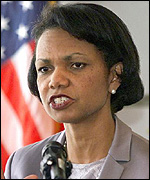
WASHINGTON (Reuters) - U.S. national security adviser Condoleezza Rice said on Tuesday the Bush administration had never accused Saddam Hussein of directing the Sept. 11, 2001, attacks on the United States.
Her statement, in an interview recorded for broadcast on ABC's "Nightline," came despite long-standing administration charges the ousted Iraqi leader was linked to the al Qaeda network accused of the Sept. 11 attacks.
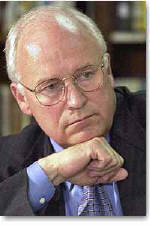
But two days earlier, Dick Cheney reasserted one already debunked Atta?Iraq Connection at Tim Russert (CNN):
"With respect to 911 of course we've had the story that's been public out there that Czechs alleged that Muhammad Atta the lead attacker met in Prague with the senior Iraqi intelligence official five months before the attack"
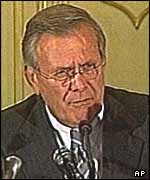
This was followed by a statement by Donald Rumsfeld on Tuesday, who said, that
AP -Wed, Sep 17, 2003
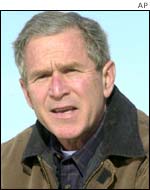
On Wednesday Bush followed with a statement, that "there was no evidence that Saddam Hussein was involved in the terrorist attacks", but "there's no question that Saddam Hussein had al-Qaida ties"
The confusion continued.
"he had no reason to believe that Iraq's Saddam Hussein had a hand in the Sept. 11, 2001, terrorist attacks"
On Wednesday, Bush spokesman Scott McClellan, "told reporters he knew of no instance in which the US leader explicitly tied Iraq to al-Qaeda's devastating suicide strikes...
On the same day, Bush distanced himself "from comments by Vice President Dick Cheney".
Democrats have accused the administration of creating the "false impression" at the heart of a widespread belief held by Americans that Saddam had a personal role in the attacks.
Bush comments came a week after a public opinion poll found that nearly 70 percent of Americans believe that Saddam's regime, which US-led forces toppled in April, was linked to the attacks that prompted the global war on terrorism.
March 18, 2003
Dear Mr. Speaker: (Dear Mr. President:)
Consistent with section 3(b) of the Authorization for Use of Military Force Against Iraq Resolution of 2002 (Public Law 107-243), and based on information available to me, including that in the enclosed document, I determine that:
(1) reliance by the United States on further diplomatic and other peaceful means alone will neither (A) adequately protect the national security of the United States against the continuing threat posed by Iraq nor (B) likely lead to enforcement of all relevant United Nations Security Council resolutions regarding Iraq; and
(2) acting pursuant to the Constitution and Public Law 107-243 is consistent with the United States and other countries continuing to take the necessary actions against international terrorists and terrorist organizations, including those nations, organizations, or persons who planned, authorized, committed, or aided the terrorist attacks that occurred on September 11, 2001.
Sincerely,
GEORGE W. BUSH
Source: Tom Tomorrow
BBC -September 18th, 2003
Bush maintains Saddam Hussein and al-Qaeda are connected
US President George Bush has said there is no evidence that Saddam Hussein was involved in the 11 September attacks.
The comments - among his most explicit so far on the issue - come after a recent opinion poll found that nearly 70% of Americans believed the Iraqi leader was personally involved in the attacks.
Mr Bush did however repeat his belief that the former Iraqi president had ties to al-Qaeda - the group widely regarded as responsible for the attacks on New York and Washington.
Critics of the war on Iraq have accused the US administration of deliberately encouraging public confusion to generate support for military action.
At a time when the credibility of government intelligence and information is under the spotlight, President Bush probably had little choice but to scotch the confusion, says the BBC's Ian Pannell in Washington.
But if the public believes that they were given the wrong impression by the administration, then there may be a political cost involved with the presidential campaign under way, our correspondent says.
...
StarTribune -09/17/2003
Dick Cheney is not a public relations man for the Bush administration, not a
spinmeister nor a political operative. He's the vice president of the United
States, and when he speaks in public, which he rarely does, he owes the
American public the truth.
In his appearance on "Meet the Press" Sunday, Cheney fell woefully short of
truth. On the subject of Iraq, the same can be said for President Bush, Defense
Secretary Donald Rumsfeld and his deputy, Paul Wolfowitz. But Cheney is the
latest example of administration mendacity, and therefore a good place to start
in holding the administration accountable. The list:
Cheney repeated the mantra that the nation ignored the terrorism threat
before Sept. 11. In fact, President Bill Clinton and his counterterrorism chief,
Richard Clarke, took the threat very seriously, especially after the bombing
of the USS Cole in October 2000. By December, Clarke had prepared plans for a
military operation to attack Osama bin Laden in Afghanistan, go after terrorist
financing and work with police officials around the world to take down the
terrorist network.
Because Clinton was to leave office in a few weeks, he decided against
handing Bush a war in progress as he worked to put a new administration together.
Instead, Clarke briefed national security adviser Condoleezza Rice, Cheney
and others. He emphasized that time was short and action was urgent. The Bush
administration sat on the report for months and months. The first high-level
discussion took place on Sept. 4, 2001, just a week before the attacks. The
actions taken by the Bush administration following Sept. 11 closely parallel
actions recommended in Clarke's nine-month-old plan. Who ignored the threat?
Cheney said that "we don't know" if there is a connection between Iraq and
the Sept. 11 attacks on the United States. He's right only in the sense that
"we don't know" if the sun will come up tomorrow. But all the evidence
available says it will -- and that Iraq was not involved in Sept. 11.
Cheney offered stuff, but it wasn't evidence. He said that one of those
involved in planning the attack, an Iraqi-American, had returned to Iraq after the
attack and had been protected, perhaps even supported, by Saddam Hussein. That
proves exactly nothing about Iraq's links to the attack itself.
Cheney also cited a supposed meeting in Prague between hijacker Mohamed Atta
and a senior Iraqi intelligence officer -- but the FBI concluded that Atta was
in Florida at the time of the supposed meeting. The CIA always doubted the
story. And according to a New York Times article on Oct. 21, 2002, Czech
President Vaclav Havel "quietly told the White House he has concluded that there is
no evidence to confirm earlier reports" of such a meeting.
Moreover, the United States now has in custody the agent accused of meeting
with Atta. Even though he must know how much he would benefit by simply saying,
"Yes, I met Atta in Prague," there has been no announcement by the
administration trumpeting that vindication of its belief in an Iraq-Sept. 11 link.
In trying to make that link, Cheney baldly asserted that Iraq is the
"geographic base" for those who struck the United States on Sept. 11. No, that would
be Afghanistan.
On weapons of mass destruction, Cheney made a number of statements that
were misleading or simply false. For example, he said the United States knew Iraq
had "500 tons of uranium." Well, yes, and so did the U.N. inspectors. What
Cheney didn't say is that the uranium was low-grade waste from nuclear energy
plants, and could not have been useful for weapons without sophisticated
processing that Iraq was incapable of performing.
Cheney also said, "To suggest that there is no evidence [in Iraq] that
[Saddam] had aspirations to acquire nuclear weapons, I don't think is valid." It's
probably not valid; Saddam wanted nuclear weapons. But Cheney is changing the
subject: The argument before the war wasn't Saddam's aspirations; it was
Saddam's active program to build nuclear weapons.
Cheney also said "a gentleman" has come forward "with full designs for a
process centrifuge system to enrich uranium and the key parts that you need to
build such a system." That would be scientist Mahdi Obeidi, who had buried the
centrifuge pieces in his back yard -- in 1991. Obeidi insisted that Iraq hadn't
restarted its nuclear weapons program after the end of the first Gulf War. The
centrifuge pieces might have signaled a potential future threat, but they
actually disprove Cheney's prewar assertion that Iraq had, indeed,
"reconstituted" its nuclear-weapons program.
Cheney also said he put great store in the ongoing search for Saddam's WMD
program: "We've got a very good man now in charge of the operation, David Kay,
who used to run UNSCOM [the U.N. inspection effort]." In fact, Kay did not run
UNSCOM; for one year he was the chief inspector for the International Atomic
Energy Agency's team in Iraq.
But it's funny Cheney should mention Kay. Last summer, the leader of the
1,400-person team searching for WMD expressed great confidence that they would
find what they were looking for. He said he wouldn't publicize discoveries
piecemeal but would submit a comprehensive report in mid-September. Apparently he
has submitted the report to George Tenet at the CIA. The question now is whether
it will ever be made public; several reports in the press have suggested that
Kay has come up way short. In five months, 1,400 experts haven't found the
WMD locations that Secretary of Defense Donald Rumsfeld said before the war were
well-known to the United States.
Cheney also said that an investigation by the British had "revalidated the
British claim that Saddam was, in fact, trying to acquire uranium in Africa --
what was in the State of the Union speech." The British investigation did
nothing of the kind. A parliamentary investigative committee said the documents on
the uranium are being reinvestigated, but that, based on the existence of
those documents, the Blair government made a "reasonable" assertion and had not
tried to deliberately mislead the British people.
To explore every phony statement in the vice president's "Meet the Press"
interview would take far more space than is available. This merely points out
some of the most egregious examples. Opponents of the war are fond of saying that
"Bush lied and our soldiers died." In fact, they'd have reason to assert that
"Bush, Cheney, Rumsfeld and Wolfowitz lied and our soldiers died." It's past
time the principals behind this mismanaged war were called to account for
their deliberate misstatements.
NY Times - September 19th
On Wednesday, President Bush finally got around to acknowledging that
there
was no connection between Saddam Hussein and the terrorist attacks of
Sept. 11,
2001.
White House aides will tell you that Mr. Bush never made that charge
directly. And that is so. But polls show that lots of Americans believe
in the link.
That is at least in part because the president's aides have left the
implication burning.
President Bush himself drew a dotted line from the 9/11 attack in
declaring
the end of hostilities in Iraq. "The battle of Iraq is one victory in a
war on
terror that began on Sept. 11, 2001, and still goes on," Mr. Bush said.
He
continued the theme in his last major speech on the war.
But on Sunday, Vice President Dick Cheney went too far. He said it was
"not
surprising" that many Americans drew a link between Mr. Hussein and
9/11. Asked
if there was a connection, he replied, "We don't know."
But the administration does know, and Mr. Bush was forced to
acknowledge it
on Wednesday.
Of course, Mr. Cheney was not surprised that Americans had leapt to a
conclusion. He was particularly enthusiastic in helping them do it.
"Come back to
9/11 again," Mr. Cheney said on Sept. 8, 2002, "and one of the real
concerns
about Saddam Hussein, as well, is his biological weapons capability."
Mr. Cheney was careful then not to claim that any evidence really
linked Mr.
Hussein to the 2001 attacks. But he drew a convoluted argument about
Mr.
Hussein's ties to Al Qaeda and suggested in closing that he was not
telling all he
knew because he did not want to reveal top secrets.
Before the war began, Mr. Bush switched the justification for the
invasion
repeatedly. The argument that was most persuasive, the danger of
weapons of mass
destruction in the hands of Mr. Hussein, has fallen flat since the
weapons
have failed to turn up.
Plenty of evidence has emerged that Mr. Hussein was a bloody despot who
deserved to be ousted for the sake of his beleaguered people. But
recent polls
suggest that the American public is not as enthusiastic about making
sacrifices to
help the Iraqis as about making sacrifices to protect the United States
against terrorism. The temptation to hint at a connection with Sept. 11
that did
not exist must have been tremendous.
The Bush administration always bristles when people attempt to draw any
parallels between the quagmire in Vietnam and the current situation in
Iraq. If the
president is really intent on not repeating history, however, he should
learn
from it. The poison of Vietnam sprang from a political establishment
that was
unwilling to level with the American people about what was happening
overseas. Stark honesty is the best weapon Mr. Bush can
employ in maintaining public confidence in his leadership.
We said that we don't have any evidence to suggest a connection".
Text of a Letter from the President to the Speaker of the House of Representatives and the President Pro Tempore of the Senate
Bush rejects Saddam 9/11 link
Too little of it on Iraq
The Terrorism Link That Wasn't
Links
printed from GlobalFreePress, Confusion about 9/11-Iraq link on 2004-11-27 20:36:03