|
The act "was written with nonviolent domestic dissidents in mind.
It will be wielded as a very blunt weapon against a lot of very important movements for justice in this country that happen to disagree with the status quo.
|
|
|
Under the USA Patriot Act, civil libertarians say, judicial oversight of surveillance has been weakened and the bar for culling an individual's financial, medical, student and other records has been lowered. Its definition of terrorism could cover groups that bear little resemblance to Osama bin Laden's foot soldiers.
Such concerns form the backdrop for Attorney General John Ashcroft's appearance today before the Senate Judiciary Committee. Lawmakers are angered the administration has unilaterally moved to enhance its own anti-terror powers in combination with the tools Congress approved in October.
They intend to grill Ashcroft about an executive order that creates military tribunals, and Justice's intention to eavesdrop on some attorney-client conversations behind bars and further mingle domestic and international spying efforts.
"The Constitution was not written primarily for our convenience, but for our liberty," Sen. Patrick Leahy, D-Vt., chairman of the Judiciary Committee, said in anticipation of the Ashcroft hearing. "Any of the choices that we will face after Sept. 11 will test both our ideals and our resolve to defend them."
The president and other administration officials have repeatedly said that they will safeguard civil liberties, but the real threat of terrorist attacks requires tough measures.
"Are we being aggressive and hard-nosed? You bet,'' Assistant Attorney General Michael Chertoff told Leahy's committee last week. "In the aftermath of Sept. 11, how could we not be? Our fundamental duty to protect America and its people requires no less.''
"Black-bag searches"
One controversial section of the Patriot Act expands the government's ability to conduct so-called "black-bag searches," entering a home or business secretly to seek evidence. Typically, an individual is served with a warrant and has the opportunity to challenge a search in court.
The act set a national standard for allowing searches to take place before the target of the search is notified. It applies to any criminal case in which prior notice could harm the investigation, not just terrorism probes.
Critics cite the provision as a prime example of how law-enforcement officials used the terrorism threat to seize new powers.
"It's something that's been on the wish list for a long time," said James X. Dempsey, a civil-liberties advocate and deputy director of the Center for Democracy and Technology. "They just used this to get it through."
Another provision with broad ramifications allows federal investigators to obtain virtually any records — from those of libraries and banks, to motels and grocery stores — on the claim the material relates to a terrorism investigation.
"They don't have to say that the records relate to a suspected terrorist," Dempsey said. "The order must be granted if the government claims the records are sought for an international terrorism investigation."
Critics say such a loose standard encourages investigators to cast their net widely, requesting information about anyone who flew on a plane Sept. 11, for example, or used a computer terminal at a library frequented by a suspected terrorist.
Washington State Librarian Nancy Zussy joined with colleagues nationwide in contacting lawmakers before the bill was passed to raise concerns about making it too easy for law enforcement to review patrons' research.
Demanding probable cause for a court order "balances the privacy of the individual," she noted.
 |
 |
| HARLEY SOLTES / THE SEATTLE TIMES |
| Sen. Maria Cantwell, D-Wash., notes concerns about monitoring of e-mail under the new law. |
|
|
Congress set a five-year limit on many of the new powers in the Patriot Act, and Sen. Maria Cantwell, D-Wash., a Judiciary Committee member, said close congressional oversight was essential to ensure those new powers weren't abused.
"The attorney general has asked for a lot of new powers, and there have been other times in our history when people have asked for those new powers and later we've regretted them," she said.
Tapping online
For years, the Justice Department had sought to update law enforcement's authority to apply "pen registers'' — devices used to collect telephone-dialing information — to e-mail and Web surfing.
Now, a judge must approve installation of the device if a prosecutor asserts the information it will collect is relevant to a criminal investigation. That is a lower standard than probable cause, which is used for a traditional wiretap, because the pen register doesn't capture conversations, only numbers.
Privacy advocates fought application of that practice to computers, arguing Web and e-mail address information would inevitably reveal something about the content of Internet communications.
The counter-terror law left unanswered the question of how much Web information could be captured: just the overall address or a list of each document viewed?
"Unlike a phone call, you're suddenly revealing content,'' said Fred Cate, an Indiana University professor specializing in privacy issues. "It is impossible to obtain the address information without seeing the content of the data."
Another section of the act designed to thwart hackers allows federal agents to monitor the online activities of an individual once a service provider has identified that person as an intruder. The online surveillance can continue indefinitely with no report to a judge or the person being monitored.
Cantwell believes these high-tech measures are the chief concern for average Americans.
"Citizens are concerned that a gradual erosion might lead to something where broad systems would be in place online to monitor e-mail communications, without having some sort of judicial review," she said.
American history is rich with examples of civil liberties curtailed in times of crisis. The Alien and Sedition Acts made criticizing the government a treasonous offense in the 18th century. Abraham Lincoln suspended habeas corpus during the Civil War. More than 100,000 Japanese-Americans were incarcerated during World War II.
All those steps were specifically targeted and then rescinded when the crises passed. Civil libertarians say the current measures are so broadly drawn against an enemy not easily defined that it is difficult to predict what the lasting ramifications might be for individual rights.
"I've been shocked by the speed with which new proposals have come forward," said Dempsey of the Center for Democracy and Technology. "It's going so far so fast, I don't know that by the time it's over anybody will remember where we started.''
Terrorism redefined
Even as these new tools are being put into practice, the Justice Department is indicating it will seek increased authority to spy on domestic groups — authority that was curtailed in response to abuses in the past.
That request rankles civil libertarians already concerned about what they consider an overly broad definition of terrorism in the act.
For purposes of searches and surveillance, the measure's definition of domestic terrorism covers illegal acts "dangerous to human life" that "appear to be intended to intimidate or coerce a civilian population'' or "influence the policy of a government."
"It's broad enough,'' said Rachel King, legislative counsel at the American Civil Liberties Union, "that some of the minor violence we've seen at the WTO protests might fall into that category.
"Groups like Greenpeace clearly engage in activities where they're violating the law and could in fact be creating situations dangerous to human life," she said.
A senior Senate staffer who worked on the bill discounted such "exaggerations," saying they fail to consider societal and institutional pressures that would keep law enforcement from overstepping its authority.
"The law does give an enormous amount of discretion to our law enforcement and to our prosecutors," said the staffer, who spoke on condition of anonymity. "The value structure that people have, the political and social environment that people live in, develop their sense of what's acceptable or not."
But police and prosecutors seeking creative ways to punish lawbreakers often reinterpret laws to fit the situations they confront, and civil libertarians insist there are troubling precedents. The Racketeering Influence and Corrupt Organizations Act (RICO), for example, was passed in 1961 to strengthen federal agents' ability to pursue Mafia suspects. It has since become a tool in civil suits, and it was used to stop Operation Rescue's tactics at abortion clinics around the nation.
"At the time that RICO passed, people would have laughed if you said that RICO would be used for political protesters," King of the ACLU said.
Broad definitions
Kate Martin, director of the Center for National Security Studies, noted the FBI spied on civil-rights leaders and antiwar groups in the 1960s, and that it broadly defined terrorism in the 1980s when investigating organizations opposed to the Reagan administration's Central America policy on the grounds they were fronts for foreign terrorists.
"The FBI does not have a good track record of distinguishing between those who engage in terrorist crimes of violence and those who engage in lawful political activity for the same political objective," she said.
|
 |
| CHRISTOPHER ANDERSON / AP |
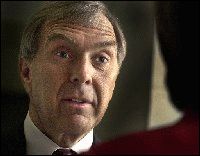
| Rep. George Nethercutt, R-Wash., hopes for a boost to the FBI in arresting eco-saboteurs. |
|
|
Rep. George Nethercutt, R-Spokane, said he expected FBI efforts to arrest eco-saboteurs — such as members of Earth Liberation Front and the Animal Liberation Front — would get a boost under the Patriot Act.
"It would be proper and it will be used," he said. Spokesmen for the FBI and the U.S. Attorney in Seattle were unable to say whether the act would be applied to ELF and ALF. A Justice Department spokeswoman didn't respond.
Several watchdog groups used demonstrations against the World Trade Organization as an example of an activity that could be redefined under the anti-terror law.
John Sellers, director of the San Francisco-based Ruckus Society that played a leading role in the 1999 Seattle protests, asserted the act "was written with nonviolent domestic dissidents in mind.
"It will be wielded as a very blunt weapon against a lot of very important movements for justice in this country that happen to disagree with the status quo," Sellers predicted.
Lisa Lange of People for the Ethical Treatment of Animals said her group expected its political enemies to try to take advantage of the law.
"The bill's intention should not be to intimidate organizations like PETA,'' she said. "I don't think it was written with that in mind. But it could be interpreted that way.''
Copyright © 2001 The Seattle Times Company
###
| 

 Add
GFP to your PALM via AvantGo
Add
GFP to your PALM via AvantGo 


