|
|
|
|
 Deception Dollars  t-shirts Sections
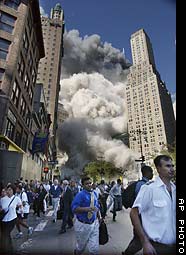
911 Main
- About - GFP HOF - My GFP - Older Stuff - Past Polls - Submit Story - Video - mp3 - SGTV SGTV/INN
Watch SGTV, our TV show, every Thursday on MNN webcast, 8 PM EST
INN is also our new breaking news partner. Their news shows incl. Interview Highlights with John Pilger, Joe Conason, Michael Meacher, Bev Harris, Cynthia McKinney, Sander Hicks and many others... 911 Encyclopedia
Ewing2001 Has compiled a comprehensive list of links an articles pertaining to 911. This is required reading for anyone interested in understanding that horrid day ESPECIALLY since the presstitutes refuse to their job.
Mike Malloy pulls no punches with the FLYING MONKEY RIGHT. If you want to hear a REAL liberal tell it like it is don't miss his show! Listen Daily 9pm to 12pm One Year Later
Tune in to get a liberal helping of the TRUTH. Peter Werbe stands up to the neo-cons and for liberal cause daily while keeping us all informed on the daily events that are shaping our world. Listen Daily 2pm till 5pm
Liberal Talk Radio In Florida! Spread the word. Tell your friends to listen in. Call the station every Saturday and give them your supportive comments (239-732-9369). Call The Guy James Show live on the air (239-530-1660). The Randi Rhodes Show
Books
All Books
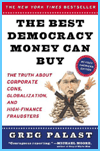
Greg Palast: Updated: with %40 more pages than the hard cover.
Alex Jones Video
Global Outlook
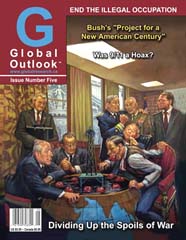
Michel Chossudovsky's Magazine on 911 and Post-911 Analysis Issue No.5-out now:Bush's "Project for a New American Century" Was 9/11 a Hoax? Diving up the Spoils of War Website Topics of the month: Was Kelly assassinated for "pulling the plug" The Forged Intelligence on Iraq Who's Who on the 9/11 "Independent" Commission Hot ranking thread: CIA closed friend with the finanzsystem of Al-Quida!
Counterpunch
|
What Happened to America? by Martin Schreaderposted by NYC on Thursday April 24, @06:34PM

  from the Politics dept.  Part One of a Three Part Series A review of the rise of fascism to power in the United States By MARTIN SCHREADER Written: April 2-15, 2003 WHEN THE REPUBLICAN Party staged its coup d'état at the end of 2000, it was the culmination of a protracted process that stretched back more than a generation. The election of Ronald Reagan as president in 1980 opened the door to the unchecked and relatively unimpeded growth of fascism in the United States. Through political organizations such as the Council of Conservative Citizens, intellectual "think-tanks" like the American Enterprise Institute, and religious and cultural formations like the Christian Coalition -- all tied by a thousand gossamer strands to the Republican Party -- a "respectable," media-friendly fascism came to occupy key positions in all aspects of capitalist society. The attacks on organized labor, democratic rights and cultural diversity (i.e., "political correctness") were all part of what rightwing politician and commentator Pat Buchanan called the "culture war." The main battleground of this "war" was found in the media. While many on the political left viewed with amusement such ridiculous scenes as former Vice President Dan Quayle taking pot shots at television characters, they ignored the underlying social message being sent: that which did not conform to the rightwing conception of "normal" is to be purged from society. Over time, the ridiculous was transformed into the sinister, as these same elements focused on the creation of a rightward shift in the main organs of the capitalist media. The exponential growth of culturally backward "shock jocks" and far-right pundits on radio and television gave this movement a platform. In 1994, this campaign took on new dimensions when Newt Gingrich led the Republican Party to control of both houses of Congress. However, the new "Class of 1994," as they were called, was not the same old conservative element that had held on to the reins of the Party for the previous century. These new Republican Congressmen were imbued with the program of the "culture war," hatred for liberalism and progressive social reform (to say nothing of antisocialism and anticommunism), loathing of "special interests" (i.e., labor, women, African Americans, etc.), and contempt for the traditional restraints capitalist democracy puts on its representatives. Armed with a definite political program, the "Contract with America," this political current carried out its agenda of repression, cloaking it in attacks on its chief rival, the Democratic Party. The provisions of the "Contract" itself met only with limited success, dependent on support from the White House or other Democratic collaborators. Concretely, the new, Republican-controlled Congress sought to enact a second rightward shift, this time in the main organs of capitalist politics, by waging war against the then-President, Bill Clinton. The 1995-1996 shutdown of the federal government was the opening salvo in this new political war of attrition. The Republicans gambled on the notion that, if Clinton and the Democrats were squeezed, they would crack. Thus, the Republican Congress carefully studied every step taken by Clinton, especially in his second term, for weaknesses. One perceived motion out of order, and Gingrich would mobilize the resources at his disposal as Speaker of the House of Representatives to launch an attack. His great opportunity came when the Monica Lewinsky scandal broke in the rightwing press. Millions of dollars, thousands of work-hours, months and months of denunciations and attacks, all aimed at pressing for articles of impeachment. Again, much of the left saw it all as an amusement or a diversion; the voices warning of dire consequences if the Republicans succeeded were rare. "Move on," was a common refrain. Speaking in terms of the impeachment drive in and of itself, it was an abysmal failure. While the House, firmly under the control of the Republican Party, was able to pass articles of impeachment, the Senate could not even muster a majority vote -- to say nothing of the necessary two-thirds majority for conviction -- on any one of the articles. However, the new Republican cadre saw that the Democratic victory was Pyrrhic. Gingrich lost the battle, but won the war. Even though Clinton would be allowed to serve out the remainder of his term, he and his party (to say nothing of political discourse in the years to come) would never be the same. It should be mentioned at this point that the Republican Party was not the only one to undergo a fundamental shift to the right. In fact, it was not even the first. After the defeat of a succession of old liberal candidates in the 1980s, there began to emerge in the Democratic Party a new formation: the Democratic Leadership Council. The DLC was composed of "centrist" elements in the party -- "reformed" Dixiecrats, Republican defectors, "Reagan Democrats," etc. The goal of the DLC was to remodel the Democratic Party so they could fill the center-right vacuum left by the emerging shift in the balance of power within the Republican Party. The DLC offered a Faustian deal to the Democratic machine: let us dictate the agenda and we will get you the White House. Ever the opportunists, the Democratic leadership fell over itself to climb aboard. The liberal base of the party was cut loose of its moorings, while also given a stern warning: follow our lead or we will bury you. The result was the electoral victory of Bill Clinton and, de facto, the establishment of DLC hegemony over the Democratic Party. Continued.
WHEREAS THE 1992 election saw the emergence of the DLC (the "neo-liberals") as the pre-eminent force in the Democratic Party, the 2000 election saw the emergence of the "neo-conservatives" as the leadership of the Republican Party. The election saw neo-liberal Vice President Al Gore take on neo-conservative George W. Bush, with local Democratic politicians acting as political police to keep the adrift liberals from straying too far -- i.e., in the direction of the Green Party's Ralph Nader. It was no slip of the tongue when Bush declared during the debates that the difference between himself and Gore was one "of opinion, not principle." Indeed, when one placed the programs of the Gore and Bush campaigns side-by-side, they strained to find any fundamental difference between them -- even on issues that, only a generation before, defined the contours of each party's policies. Then there was Gore's running mate, Joseph Lieberman, the anointed candidate of the DLC. Bush's statement that the differences were only matters of "opinion" was, looking back, an intentional contrivance designed for mass consumption. Or, more accurately, it was contrivance for the Republicans and fear for the Democrats. The oxymoronic philosophy of "compassionate conservatism," codified in the 2000 platform of the Republican Party, was meant to break through the stagnation in public opinion stemming from their defeat in the impeachment drive. For the neo-liberal Democratic leadership, "compassionate conservatism" seemingly threatened their tenuous hold on the "moderate" vote. Thus, the DLC, now controlling the Democratic National Committee, pushed the party's platform further to the right, challenging Bush's "compassionate conservatism" with its own. However, it would be incorrect to see this symmetry in the two parties' platforms as anything other than conjunctural. They paralleled each other at a specific moment in history -- the parallel itself a product of history. It represented confirmation that the relatively modest goals set by those who organized and fostered the fascist elements in the Republican Party (a section of the capitalist class that had grown tired of democratic forms), aimed at narrowing the base of democratic governance in the U.S., had been achieved. They saw that the work of both parties over the decades had effectively locked out alternative "third parties" -- especially workers' political parties -- from any meaningful role in the political process. They saw the numbers of voters drop because of a concerted campaign to evoke revulsion in the minds of working people at what passed for "politics." Massive cuts in social services, welfare, wages and benefits meant that workers were more concerned with waging the "battle for survival" than the "battle for democracy." Co-optation of the "official" leaderships of labor organizations, such as seating the president of the United Auto Workers on the Board of Directors of DaimlerChrysler, meant that the steady erosion of gains won by unions in the 1930s and 1940s now became a flood. The various women's rights, civil rights and democratic struggles were daisy-chained back to the Democratic Party (and, thus, to the DLC) by way of well-funded "grassroots" organizations and "pressure groups" -- usually headed by a prominent, media-savvy, or media-selected, spokesperson (e.g., Jesse Jackson). With all of the arrangements cited above in place, it was time to strike. With working people either atomized and searching for ways to survive, or bound politically to the Democratic Party leadership, and with the effective ban on allowing workers' political parties to challenge them seriously, the Republicans had only to bring the election numbers close enough to make a relatively bloodless coup. In effect, the Republicans now set into motion a "revolution in permanence" of its own -- a "counterrevolution in permanence," to be more precise. For this, they relied to a certain degree on the emerging popularity of Nader's Green Party campaign -- to either siphon off Democratic votes or to keep potentially independent challengers divided and in check. However, using the Green campaign was a calculated risk, as could be seen from the sudden drop in the projected percentage of the vote Nader was expected to receive (a drop that continued through Election Day). The Democratic Party faithful, nevertheless, use the fact that Nader received a sizeable amount of votes to hold him solely responsible for the events of the last period -- in spite of the fact that the margin between Bush and Gore was so small that even a relatively minor candidate could also be seen as a culprit. But, to hold Nader's campaign responsible for the failure of the Democrats, the rise of the fascist wing of the Republican Party to power, and the wholesale destruction of American democracy (limited though it was), is little more than the raising of a bogeyman meant to shift attention away from the decades-long process, carried out by both parties, to systematically remove working people from the political process. It is like blaming the death of an AIDS victim solely on the pneumonia he or she had in the last days of their life. IT IS PERHAPS valuable at this point to step away from this particular moment in history and look more closely at the genesis and development of the situation in the United States today. Repeatedly, this author has referred to the Republican Party either as a coalition of fascists and neo-conservatives, or simply as a fascist party. Now is as good an opportunity as any to answer the question: What is fascism? There are, of course, many definitions of fascism. The American Heritage Dictionary of the English Language, for example, defines fascism as "a system of government marked by centralization of authority under a dictator, stringent socioeconomic controls, suppression of the opposition through terror and censorship, and typically a policy of belligerent nationalism and racism." While, in and of itself, this definition is a fair description of what a fascist state looks and acts like, it is by no means accurate enough. To one degree or another, many capitalist "democracies" around the world fit this description. That, perhaps, is a point to be explored later; but not today. Suffice to say, this definition is inadequate for understanding what fascism is (and is not). Various elements in the left ("official Communists," anarchists, syndicalists, etc.), as well, have developed theories on what fascism is. However, most of these definitions are variants on the one quoted above -- albeit with this or that singular nuance or addition. Some even take notice of the definition offered by Italian fascist, Benito Mussolini: "Fascism should rightly be called corporatism, as it is a merger of state and corporate power." While one aspect of fascism is such an open and blatant integration, which expresses itself in the extension of the totalitarianism one sees in the very existence of capitalism (private property) into all aspects of society, the merger of "state and corporate power" has been, in fact, a defining characteristic of capitalism throughout the 20th century. The very concepts of "state monopoly capitalism," "imperialism" and nationalization involve, to one degree or another, such a merger as expressed by Mussolini. What is lacking from these definitions is an understanding of the dynamics of fascism: how it developed, what forces -- primarily class forces -- were at work, and what material conditions allowed for its ascension. In this respect, it may perhaps be important to review the definition offered by the Russian Marxist, Leon Trotsky. What makes Trotsky's definition of fascism stand out is that it attempts to analyze these dynamics and place them in their proper context. In his article, "Bonapartism, Fascism and War" (the last article he wrote before being assassinated by a Stalinist agent), Trotsky lays out a definition of fascism that, in its specificity and formulaic narrowness, provides a fair guide by which we can judge whether or not fascism is at work. He writes: "Insofar as the proletariat proves incapable at a given stage of conquering power, imperialism begins regulating economic life with its own methods; the political mechanism is the fascist party, which becomes the state power. The productive forces are in irreconcilable contradiction not only with private property but also with national boundaries. Imperialism is the very expression of this contradiction. Imperialist capitalism seeks to solve this contradiction through an extension of boundaries, seizure of new territories, and so on. The totalitarian state, subjecting all aspects of economic, political, and cultural life to finance capital, is the instrument for creating a supranationalist state, an Imperialist empire, ruling over continents, ruling over the whole world. "All these traits of fascism we have analyzed each one by itself and all of them in their totality to the extent that they became manifest or came to the forefront. "Both theoretical analysis and the rich historical experience of the last quarter of a century have demonstrated with equal force that fascism is each time the final link of a specific political cycle composed of the following: the gravest crisis of capitalist society; the growth of the radicalization of the working class; the growth of sympathy toward the working class and a yearning for change on the part of the rural and urban petty bourgeoisie; the extreme confusion of the big bourgeoisie; its cowardly and treacherous maneuvers aimed at avoiding the revolutionary climax; the exhaustion of the proletariat; growing confusion and indifference; the aggravation of the social crisis; the despair of the petty bourgeoisie, its yearning for change; the collective neurosis of the petty bourgeoisie, its readiness to believe in miracles, its readiness for violent measures; the growth of hostility towards the proletariat which has deceived its expectations. These are the premises for a swift formation of a fascist party and its victory." (L.D. Trotsky, "Bonapartism, Fascism and War," The Struggle Against Fascism in Germany, Pathfinder (New York), 1977 -- http://www.marxists.org/archive/trotsky/works/1930-ger/400820.htm ) The first and third paragraphs of this article are the ones that concern us the most. The latter outlines the general pattern of events that lead to a fascist takeover; the former paragraph describes the development of a fascist regime after assuming power. Let us concern ourselves for the moment with the latter paragraph, and compare the criteria listed in it to what we have seen unfold in the last four decades in the United States. End of Part One of a Three Part Article by Martin Schreader. Part Two will be published soon.
< North Korea Threatens Demonstration or Export of Nuclear Weapons | US Officials: WMD wasn't main reason for war > |
Global Free Press Login
Related Links
| ||||
|
||||||
|
[ home | contribute story | older articles | past polls | faq | authors | preferences ]
FAIR
USE NOTICE: This
site contains copyrighted material the use of which has not always been
specifically authorized by the copyright owner. We are making such material
available in our efforts to advance understanding of environmental, political,
human rights, economic, democracy, scientific, and social justice issues,
etc. We believe this constitutes a 'fair use' of any such copyrighted material
as provided for in section 107 of the US Copyright Law. In accordance with
Title 17 U.S.C. Section 107, the material on this site is distributed without
profit to those who have expressed a prior interest in receiving the included
information for research and educational purposes. For more information
go to: http://www.law.cornell.edu/uscode/17/107.shtml
If you wish to use copyrighted material from this site for purposes
of your own that go beyond 'fair use', you must obtain permission from the
copyright owner.
Powered by daVinci Interactive and Slashcode
 Add
GFP to your PALM via AvantGo
Add
GFP to your PALM via AvantGo
Add GFP HeadLines to your site XML
or RDF
Questions or Comments
Regarding This Site
webmaster@globalfreepress.com