|
U.S. Officials Cite Importance of African Oil to U.S. Economy
In this press release, the US State Department "stressed the growing importance of African oil to the U.S. economy at a [January 2002] energy seminar, among them ...Kansteiner, who "rushed from a meeting with Secretary of State Colin Powell to make that point".
Kansteiner, a former businessman with the Scowcroft Group, an international consulting firm -among their members are Kissinger-friend Brent Scowcroft, Ambassador Gillespie, Arnold Kanter (ex-RAND director) or Virginia Mulberger (ex-Air Force Officer)- spoke at a January 25 breakfast meeting entitled "African Oil: A Priority for U.S. National Security and African Development," sponsored by the Institute for Advanced Strategic and Political Studies (IASPS): "It is undeniable," he said, "that this [oil] has become of national strategic interest to us."
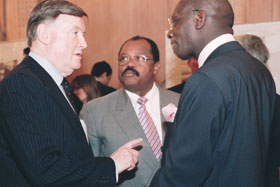
Photo: (from left to right) John Flynn, ChevronTexaco adviser; Angolan Ambassador Antonio DaCosta Fernandes; and Senegalese Ambassador El Hadj Amadou Niang (Feb 17th, 2003 meeting: ChevronTexaco’s "commitment" to combating HIV and AIDS in Africa)
Supporting this strategy was also John Flynn, a former British foreign service officer who is now an executive with Chevron/Texaco.
In the same seminar, former U.S. Air Force Lt. Colonel Karen Kwiatkowski, a political/military officer, at that time assigned to the secretary of defense's Office of African Affairs, also emphasized that "Africa is important to U.S. national security." .

Meanwhile, Karen Kwiatkowski seems to fight on the other side.
Kwiatkowski retired in early 2003, now reporting for lewrockwell.com, criticising Paul Wolfowitz, Donald Rumsfeld and other NeoCons.
"...Referring to the National Intelligence Council's "Global Trends 2015" report, which came out last December, Kwiatkowski pointed out that 25 percent of U.S. oil imports in 2015 will come from sub-Saharan Africa. The prime "energy locations" identified in the study are West Africa, Sudan, and Central Africa..."
It becomes very clear, that the US Interests in Africa are not about yet another "liberation" or "war against terrorism" and definetely not about "a new fight against AIDS".

It just smells bad, when Randall Tobias, new head of the African-AIDS program came from former CIA contractor Eli Lily -with best ties to the Bush Family since the 70s.
At this oil seminar in February 2002, Robert Murphy, an economic specialist with the State Department's Office of African Analysis, stressed it very bold:
Africa is important to "the diversification of our sources of imported oil away from the troubled areas of the Middle East and other politically high-risk areas".
The February 2002 "african oil-event" was also picked up in the November 2002-issue of Alexander Gas + Oil.
Mentioning an updated report, its new purpose was now to displace Saudi Arabia "as major crude oil supplier" with Nigeria.
This policy shift by AOPIG was supported by IASPS (the Institute for Advanced Strategic and Political Studies).
On July 14th, 2002, AOPIG pointed out, how important Nigeria should become for the United States.
Unsurprisingly, as we learned in early July 2003, Nigeria played also a big role in the "liberation" of Liberia:
Liberian President Charles Taylor, under U.S. pressure to quit, said he had accepted an offer of asylum in Nigeria.
Did the United States have a secret pact with Nigeria?
One year earlier, in July 2002, the IASPS analysed the situation in Nigeria like this:
"...According to a leading member of the group and Fellow of the American Institute for Advanced Strategic and Political Studies, Dr. Paul Michael Wihbey, the US is hoping to double its oil imports from Nigeria from 900,000 barrels per day to around 1.8 million barrels daily in the next five years...
...Nigeria is currently the fifth largest exporter of crude oil to the US behind Canada (1.8 million bpd), Saudi Arabia 1.4 million bpd, Mexico and Venezuela at 1.4 million bpd.
But the increasing tension in the Middle East ...and the political instability in the Latin American country of Venezuela, have been giving the Americans major concern…."
As we learned, a failed coup d'etat in Venezuela didn't work out for the United States, therefore the US had to manipulate the WMD evidence of Iraq, to send their troops and companies (KBR Halliburton, Bechtel etc...) over there as soon as possible.
However, the peak oil situation was well known, years before Sep11th. One can assume, that the war against Iraq was well planned, only one reason was needed urgently: The Sep11th attack.
Was the attack really just a helpful coincidence?
The Oil in Iraq can't be developed in a speed, the United States would like to have it, they also need South American and African Oil.
In July 2002, the IASPS reported, that IASPS’s Paul Michael Wihbey met in Nigeria "with other members of IASPS and the African Oil Policy Initiative Group. ...The IASPS delegation held hours of working meetings with Nigerian President Obasanjo and Vice President Atiku Abubakar..." An article from July 11th, 2002 mentioned, that "these meetings were extremely useful
Other papers from the IASPS about african oil strategies can be find at the IASPS's Africa Oil Policy Initiative Group (AOPIG), including some white papers.
Their report "African Oil: A priority for US National Security and African Development" became popular in the beginning of 2002,
but parts of it had been already mentioned in a May 2001 US National Energy Policy Report.
On January 25th, 2002, the "African Oil" seminar chose the title of the IASPS-report as their header:
"A Priority for US National Security and African Development"
"..The seminar brought together assistant secretary of state for African Affairs Walter Kansteiner, and the ambassadors of Nigeria, Cameroon, Algeria, Ghana, Equatorial Guinea, Namibia and Congo-Brazzaville..."
One need not to be a rocket scientist to connect the dots between the cover-up of the real truth about September 11th, the War in Iraq, peak oil and the role of IASPS/PNAC in this puzzle:
In 1996, the IASPS also published the controversial paper by Richard Perle and Douglas Feith titled, "A Clean Break: A New Strategy for Securing the Realm," which advised incoming Israeli Prime Minister Benjamin Netanyahu to renege on the Oslo Peace Process.
"...Another member of the committee was David Wurmser, who is now a senior adviser to John Bolton, the Under-Secretary for Arms Control and International Security, and the State Department's most hawkish senior official. In 1999, Wurmser published a book (with a foreword by Richard Perle) called "Tyranny's Ally: America's Failure to Defeat Saddam Hussein." It provides a detailed description of a dramatically improved Middle East, from the hawk point of view, after regime change in Iraq.
Other members of the blueprint committee for PNAC: James Colbert (Jewish Institute for National Security Affairs), Charles Fairbanks, Jr.(Johns Hopkins University/SAIS -->), Robert Loewenberg (President IASPS), David Wurmser (IASPS), and Meyrav Wurmser (Johns Hopkins University) or Jonathan Torop (The Washington Institute for Near East Policy).
The committee and this paper later inspired PNAC for another blueprint of a regime change in Iraq.
More at the Oil-Section of GFP.
| 





 ]
]