
Deception Dollars

t-shirts
Sections
Main
SGTV/INN

MUST SEE: 911 Documentry
Watch SGTV, our TV show, every Thursday on MNN webcast, 8 PM EST

Watch INN World Report, our new cooperation partner, every Friday (Repeats on Saturday + Sunday) on Free Speech TV, MNN and many other Public Access Channels, 6 PM EST.
INN is also our new breaking news partner. Their news shows incl. Interview Highlights with John Pilger, Joe Conason, Michael Meacher, Bev Harris, Cynthia McKinney, Sander Hicks and many others...
911 Encyclopedia

Ewing2001 Has compiled a comprehensive list of links an articles pertaining
to 911.
This is required reading for anyone interested in understanding that horrid
day ESPECIALLY since the presstitutes refuse to their job.
more...
Search

9/11 News and GFP-911 Archive

Mike Malloy
Mike Malloy pulls no punches with the FLYING MONKEY RIGHT. If you want to
hear a REAL liberal tell it like it is don't miss his show!
Listen Daily 9pm
to 12pm
One Year Later

Peter Werbe
Tune in to get a liberal helping of the TRUTH. Peter Werbe stands up to the
neo-cons and for liberal cause daily while keeping us all informed on the daily
events that are shaping our world.
Listen Daily 2pm till 5pm

Liberal Talk Radio In Florida!
Spread the word. Tell your friends to listen in. Call
the station every Saturday and give them your supportive
comments (239-732-9369). Call The Guy James Show live
on the air (239-530-1660).
The Randi Rhodes Show

more...
Internet Radio/Tv For Progressives
Books
Alex Jones Video
Global Outlook

Michel Chossudovsky's Magazine on 911 and Post-911 Analysis
Issue No.5-out now:
Bush's "Project for a New American Century"
Was 9/11 a Hoax?
Diving up the Spoils of War
Website Topics of the month:
Was Kelly assassinated for "pulling the plug"
The Forged Intelligence on Iraq
Who's Who on the 9/11 "Independent" Commission
Hot ranking thread:
CIA closed friend with the finanzsystem of Al-Quida!
GLOBAL RESEARCH (CANADA) : FEATURE ARTICLES
25 November - 3 December 2003
Iraq: The Truth on the
Convoy which was attacked while driving through
Samara
The Rise of a New Dictatorship in Iraq , Firas Al-Atraqchi
The FTAA Protests: This is What Democracy Looks Like in Miami, Al Crespo
Enforcing Globalization: New World Order Weapons, John Valleau
Police State in America:
Bush’s Operation Clean Sweep: World War IV in
2004? John Stanton
Manipulating Pathologic Evidence: The David Kelly Story: Turning Murder
into Suicide, Rowena Thursby
The Legend of 9/11: Coincidence or Conspiracy: The Tale of The Millennial
Bomber, Chaim Kupferberg
Assassination of Reuters Cameraman, who had uncovered evidence of Mass US
Casualties in Iraq, Felicity Arbuthnot
Legal Scam in Denmark:
Danish government lawyers removed preconditions
for invasion of Iraq, Coilín Oscar ÓhAiseadha
Le Général Franks doute que la Constitution survive à une
attaque aux ADM
(armes de destruction massive) , John O. Edwards
Who’s Holding All the Cards?... The Bipartisan War Agenda, Michel
Chossudovsky & Ian Woods
Being "Against the War" is now a "Terrorist Act":
FBI
Targets Anti-War Activists
Counterpunch
|
(Open Headlines Popup Window)
posted by Mactyler
on Saturday July 19, @03:39AM


from the iamaw.org dept.
The recession may be over, but the jobless recovery continues unabated.
July 3, 2003
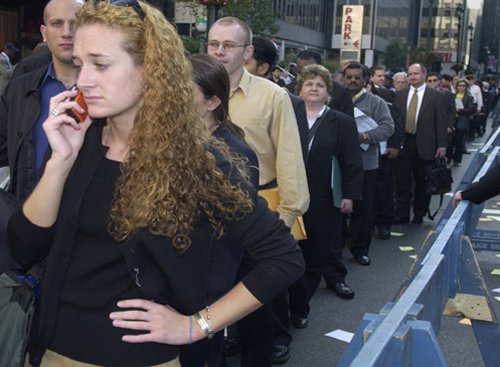
Unemployment rate jumps, while payrolls decline
The nation's unemployment rate unexpectedly jumped to 6.4% in June, reaching not only the highest rate of joblessness since the recession began in March 2001, but also the highest unemployment rate since April 1994. According to today's report from the Bureau of Labor Statistics, the number of job seekers stands at 9.4 million, an increase of 3.3 million since the peak of the last business cycle. Payrolls contracted for the fifth consecutive month, by 30,000. While this represents a considerably smaller loss than last month's revised payroll decline of 70,000, the jobless recovery shows few signs of abating.
In fact, labor market trends have grown somewhat more negative over the past six months. Between December 2002 and June of this year, payrolls are down by 236,000 and unemployment is up by 0.4 percentage points. Over the previous six-month period—June 2002 through December 2002—payrolls were down 185,000 and unemployment up by 0.2 points. Since the onset of the recession, total employment is down 2.6 million and the private sector has lost 3.1 million jobs.
Two important trends are contributing to the rise in unemployment. First, the labor force grew quickly last month, adding 611,000 persons. One factor holding back the growth of unemployment in earlier months has been slower labor force growth, as potential job seekers chose not to look for work in such a weak job market. If the number of job seekers joining the job market continues to accelerate in a jobless environment, it will put upward pressure on the jobless rate.
A second revealing trend is the duration of time spent unemployed, an indicator of the difficulty facing job seekers. Both the median and average number of weeks spent seeking work grew last month, and both remain stuck at recessionary levels. In fact, these duration levels have historically been associated with much higher unemployment rates, suggesting today's rate of 6.4% understates the degree of labor market weakness. The median unemployment duration of 12.3 weeks is the highest this series has reached since it began in July 1967 (the series also hit this level in May 1983, when the unemployment rate was at 10.1%). The last time the average number of weeks of unemployment was higher than today's average of 19.8 was in August 1983, when the series hit 20 weeks and the unemployment rate was 9.5%.
The underemployment rate—which, in addition to the unemployed, includes part-time workers who would rather be working full time and discouraged workers no longer seeking jobs—rose to 10.3% in June, the highest rate since September 1994 (this series is seasonally adjusted by EPI, not by the BLS, and thus is not an official BLS statistic).
Factory employment was cut by 56,000 last month, close to the average monthly loss of 53,000 over the past year. June marks the 35th consecutive month of declining payrolls in manufacturing.
Service employment was mixed, up 10,000, with losses in retail trade, wholesale trade, information technology, transportation, and telecommunications offset by gains construction, mortgage banking, and health services, three industries that have remained somewhat insulated from the negative forces affecting most other sectors. Continued hiring in the temp sector—up 82,000 over the past two months—may indicate that employers are testing the waters, unwilling to commit to permanent hires, but feeling more confident about the future.
The persistently high unemployment is leading to slowed wage growth. Measured on a quarterly basis, nominal hourly wages grew at an annualized rate of only 2% in the second quarter, the slowest growth rate since the first quarter of 1988. Since weekly hours of work have also been stagnant in recent months, weekly earnings have grown even more slowly, at an annualized rate of 1.2% in the second quarter. Even with low inflation, such slow wage growth may constrain consumption moving forward.
In recent news accounts, many economic analysts have been predicting a strong second half of this year in terms of GDP growth. Today's Wall Street Journal, for example, features a survey of economists predicting second-half GDP growth of about 3.7%. However, since this rate of growth is only slightly above the expected growth rate given the growth in the labor force and productivity (our potential growth rate), even this optimistic forecast will only reduce unemployment slightly in the second half of 2003. The implication is that jobless rates will be stuck in the 6% range for at least the next few quarters, and full employment—4% or lower—is unlikely to be reached in the foreseeable future.
These analysts may well be underestimating the extent to which persistent labor market weakness will dampen consumer spending, and thus investment, for the rest of the year (note that investment is held back not by the very low cost of capital, but by weak consumer demand). Despite the optimists' predictions, if lack of jobs, high unemployment, and slower wage and income growth persist, the jobless recovery will be prolonged.
—Jared Bernstein
with research assistance by Brendan Hill
The Economic Policy Institute JOBS PICTURE is published each month upon release of the Bureau of Labor Statistics' employment report.
< Blair in Japan asked to Resign: "Blood on his Hands"
| IraqGate- Kelly's last Email: "Many dark Actors playing Games" >
|
Global Free Press Login
Related Links
|

 Add
GFP to your PALM via AvantGo
Add
GFP to your PALM via AvantGo