| |
  |
| What's Left? A New Life for Progressivism |
|
 |
|
posted by admin
on Sunday November 25, 2001 @04:57 PM
from the commondreams.org dept.
|
|
|
|
|
 Published
on Sunday, November 25, 2001 in the Los Angeles
Times
Published
on Sunday, November 25, 2001 in the Los Angeles
Timesby
Katrina vanden Heuvel and Joel Rogers
NEW YORK -- In the aftermath of Sept. 11, pundits were quick to proclaim the American
left a victim of the war on terrorism, for two reasons.
The first is that progressives, since Vietnam, have stood solidly in opposition
to the use of U.S. military force. This stance could be honorably maintained then
and during a host of sordid U.S. military ventures since, but leaves them unbalanced
or marginal in today's case, where force seems justified.
The second is that this war is about securing the "open society" that terrorism
threatens--a society in which individual and corporate freedoms, resting on secure
property rights, can be exercised worldwide without restraint. But the left--in
its World Trade Organization protests in Seattle and Genoa, in its opposition
to fast track--has been most visible for opposing the corporate domination that
naturally follows from such rules. And so, the pundits reason, any left support
now for the war against terrorism is at odds with its recent actions. But this
reasoning strikes us as wrong. Only the pacifist left has ever opposed all use
of U.S. military force; other progressives simply have strong views on when it
is appropriate and believe that blank, ubiquitous endorsement of military action
does not serve the country. And there is no reason to equate opposition to terrorism,
a crime against humanity, with support for a particular program on how humanity
should be organized, a matter that remains a subject of legitimate debate.
If anything, the war on terrorism creates an opening for progressives, not
closure--indeed, it presents the opportunity of a lifetime.
|
|
|
|
|
posted by admin
on Sunday November 25, 2001 @04:52 PM
from the commondreams.org dept.
|
|
|
|
|
|
Published
on Sunday, November 25, 2001 in the Boulder
Daily Camera by
Courtland Milloy
WASHINGTON — A few questions, please:
Why are we so happy that Afghans can now fly kites, shave their beards and
wear short skirts when so few of us seemed to care about their plight before Sept.
11?
What about the millions of Afghans who are in danger of starvation this winter?
Are they, too, flying kites amid the land mines and unexploded cluster bombs?
Why does Britain's Prime Minister Tony Blair get a warm embrace for helping
us wage war, but when Gordon Brown, Britain's chancellor of the exchequer, asks
us to do more to help the world's poor, we give him a cold shoulder?
|
|
|
|
|
| The War for Oil Subtext in Afghanistan |
|
|
|
posted by admin
on Sunday November 25, 2001 @04:50 PM
from the commondreams.org dept.
|
|
|
|
|
|
Published
on Sunday, November 25, 2001 by
Fran Shor
A recent article in the "Washington Post" provided a brief but revealing portrait
of the role of US Special Forces in Afghanistan. The story was not about searching
out Bin Laden and his followers in the caves of Afghanistan. Instead, the "Post"
reported on a US Special Forces operation aimed at interdicting and destroying
Iranian oil shipments to Afghan cities. According to the report, the trucks carrying
the oil were destroyed by the camouflaged and goggled-eyed soldiers. Shouting
"terrorists" at the frightened Iranian truck-drivers, the Special Forces handcuffed
the drivers and led them away from where the trucks were then blown to bits. Although
not harmed physically, the Iranians were completely baffled by why they were targets
of such an attack, especially given the alleged civilian customers.
The reader of the story might also be baffled as to why US Special Forces would
conduct such an operation. Certainly, one could argue from the Pentagon's perspective
that delivering precious fuel to potential Taliban supporters would constitute
an important target. Of course, acknowledging that military targets encompass
fuel supplies raises questions about how precise and restricted these military
targets are. In fact, the Pentagon has conducted its military campaign in Afghanistan
with weapons (e.g., cluster bombs) and targets (e.g. power stations) that put
civilians, in particular, at risk.
|
|
|
|
|
| Aftershocks
That Will Eventually Shake Us All |
|
|
|
posted by admin
on Sunday November 25, 2001 @04:48 PM
from the commondreams.org dept.
|
|
|
|
|
|
Published
on Sunday, November 25, 2001 in the Observer
of London by
Fred Halliday
A new international order may not have emerged from the cauldron of 11 September,
but it is not too early to discern the outlines of the emerging world.
September did not change everything: the map of the world, the global pattern
of economic and military power, the relative distribution of democratic, semi-authoritarian
and tyrannical states remains much the same. Many of the problems which are least
susceptible to traditional forms of state control (the environment, migration,
the drugs trade, Aids) long predated 11 September.
|
|
|
|
|
| Desperately in Search of a Health-Care Blueprint |
|
|
|
| Features: Author Gore Vidal Slams U.S. for Waging 'Perpetual War' |
|
|
|
posted by admin
on Sunday November 25, 2001 @12:12 PM
from the commondreams.org dept.
|
|
|
|
|
|
Published
on Saturday, November 24, 2001 by Reuters
by Stephanie Holmes
ROME - Outspoken U.S. writer Gore Vidal has denounced Washington for waging what
he called ``a perpetual war for perpetual peace'' and said American aggression
was only nurturing fresh hatreds.
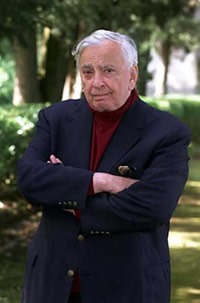
Outspoken U.S. writer Gore Vidal has denounced Washington for waging what he called
'a perpetual war for perpetual peace' and said American aggression was only nurturing
fresh hatreds. Vidal is seen at his home in Ravello, southern Italy, on May 9,
2001. (Salvatore Laporta/Reuters)
|
In a scathing attack on U.S. foreign policy, Vidal told Reuters that the United
States would have been better served trying to buy peace with Osama bin Laden
rather than send in the bombers to try and kill him.
Vidal, one of contemporary America's harshest critics, has had trouble finding
an audience for his views back home and is publishing his latest collection of
essays in his adoptive country, Italy.
``Anyone can describe what happened but you have to think to realize why Osama
bin Laden did what he did. This is hard work and it will make you very unpopular,''
he said in an interview late on Thursday.
|
|
|
|
|
| Features: The Siege of Kunduz is a Defining Moment For Us All |
|
|
|
posted by admin
on Sunday November 25, 2001 @12:06 PM
from the commondreams.org dept.
|
|
|
|
|
|
Published
on Saturday, November 24, 2001 in the Independent/UK
'From my own experience of siege conditions, I can testify that the atmosphere will be thick with panic'
by Fergal Keane
We have come to a moment of crucial moral choice in the still young century. It
has arisen because of a dust-blown town whose name may yet come to rank among
the sites of the most notorious atrocities of the last 100 years.
Kunduz. A place that might become like My Lai in Vietnam, Hama in Syria or
Sabra and Shatila in Lebanon. Or maybe not. For Kunduz is not yet the chronicle
of a massacre foretold. There is still time to save the city and the 300,000 people
– fighters and civilians – besieged within its perimeters.
This could depend on whether the Taliban commanders are willing to surrender
or prepare to fight to the death. Either way, there are serious doubts as to how
the fighters of the Northern Alliance will behave. If there is a surrender, will
they slaughter the foreign Taliban, as has been hinted? Or, if there is a battle
and the Alliance emerges victorious, will they embark on a bloody rampage?
|
|
|
|
|
posted by admin
on Sunday November 25, 2001 @11:58 AM
from the nytimes.com dept.
|
|
|
|
|
|
published November 25, 2001
@ http://www.nytimes.com
By PAUL KRUGMAN
Most Americans get their news from TV. And what they see is heartwarming — a picture of a nation behaving well in a time of crisis. Indeed, the vast majority of Americans have been both resolute and generous. But that's not the whole story, and the images TV doesn't show are anything but heartwarming. A full picture would show politicians and businessmen behaving badly, with this bad behavior made possible — and made worse — by the fact that these days selfishness comes tightly wrapped in the flag. If you pay attention to the whole picture, you start to feel that you are living in a different reality from the one on TV.
The alternate reality isn't deeply hidden. It's available to anyone with a modem, and some of it makes it into quality newspapers. Often you can find the best reporting on what's really going on in the business section, because business reporters and commentators are not expected to view the world through rose-colored glasses.
|
|
|
|
|
| Better Gas Mileage, Greater Security |
|
|
|
posted by admin
on Sunday November 25, 2001 @12:45 AM
from the nytimes.com dept.
|
|
|
|
|
|
published November 24, 2001 @ http://www.nytimes.com
By ROBERT F. KENNEDY JR.
It has become clear to most Americans that maintaining our national security will require reducing our dependence on foreign oil. But Republicans are using the current crisis to push through a reckless energy agenda, including drilling in the Arctic National Wildlife Refuge, that will not improve America's security. Even the conservative Cato Institute has called President Bush's claim that Arctic oil would reduce gas prices or American dependency on foreign oil "not just nonsense, but nonsense on stilts." There is a clear and pragmatic way to reduce our dependency fast. Since 40 percent of the oil used by America fuels light trucks and cars, an increase in corporate average fuel economy standards ? called CAFE ? could have a dramatic impact.
In the late 1970's, President Jimmy Carter implemented CAFE standards to combat an oil shortage driven by policies of the Organization of Petroleum Exporting Countries. The standards raised fuel efficiency in American cars by 7.6 miles a gallon over six years, causing oil imports from the Persian Gulf to fall by 87 percent. Our economy grew by 27 percent during that period. Detroit, predictably, figured out how to build more fuel-efficient cars largely without reductions in size, comfort or power.
|
|
|
|
|
posted by admin
on Sunday November 25, 2001 @12:33 AM
from the nytimes.com dept.
|
|
|
|
|
|
published November 25, 2001 @ http://nytimes.com
More Maureen Dowd Columns
WASHINGTON - A friend of mine, a liberal editor at a magazine, has been trying to get some of his staffers interested in writing about whether the Bush team's anti- terrorism measures are scorching our civil liberties. It's the sort of topic they'd usually jump at. But not this time. "As good liberals, we feel we ought to be upset but somehow we're not," my friend mused. "But why not? In part because we were really attacked this time. Before, when the president talked about national security, it was in the abstract. Now, you say, `Oh, this is national security.'
"We're all in this haze of indifference. I don't want to get into it enough to have to make a decision about how bad it is. What if I reached the conclusion that this is all terrible? Would I have to start protesting in the streets? I'm not in the mood for a big civil libertarian crisis." With supreme ambivalence, we are embarking on the Ashcroft era in American justice. The Economist writes that the attorney general's assault on evil has "a Cromwellian feel," noting dryly: "England's Lord Protector also disapproved of drinking, dancing and smoking."
|
|
|
|
|
| These Refugees Are Our Responsibility |
|
|
|
posted by admin
on Thursday November 22, 2001 @01:33 PM
from the commondreams.org dept.
|
|
|
|
|
|
Published on Thursday, November 22, 2001 in the Independent/UK
'If it were not for the missiles sent into Kandahar and Kunduz, the children wouldn't have had to take to the roads'
by Natasha Walter There was a time when everyone agreed that it was harrowing just to watch the news. When everyone talked about how they cried when they saw the pictures, how they were having nightmares, how they couldn't stand to think about the grief of the people they saw on television. It was, indeed, a traumatic time, and the grief then was genuine. But now it's not so fashionable to say how disturbing you find the news, even if you have rarely seen anything so tragic as, for instance, that man on television last night holding two starving babies for whom their mother had no milk, or the little girl walking barefoot in the dust of a refugee camp that holds tens of thousands of desperate people. Why aren't we talking about how we cry when we see these people? Why don't we say that they haunt our dreams?
|
|
|
|
|
|
|


 Add
GFP to your PALM via AvantGo
Add
GFP to your PALM via AvantGo 