| |
  |
| Feeding the Hungry May Be the Prime Task of Peacekeepers |
|
 |
|
posted by admin
on Sunday December 16, 2001 @02:02 PM
from the commondreams.org dept.
|
|
|
|
|
 Published on Sunday, December 16, 2001 in the Milwaukee Journal Sentinel
by Medea Benjamin For 20 years, I have traveled the world, first as a U.N. relief worker and now as a human-rights activist. I've witnessed famine in Africa and visited burned-out villages in Central America. I have seen people dying of starvation and people dying from the wounds of war. But having just returned from Afghanistan, I now believe that few places are as absolutely horrific. Twenty-three years of war, coupled with three years of severe drought, have left a destitute and traumatized population. The U.S. bombing campaign, while helping to defeat the oppressive Taliban regime, has exacerbated the humanitarian crisis in two ways.
|
|
|
|
|
| We Refuse To Be Enemies Hartford Jews And Muslims Call for Just Peace |
|
|
|
posted by admin
on Sunday December 16, 2001 @01:53 PM
from the commondreams.org dept.
|
|
|
|
|
|
Published on Friday, December 14, 2001 in the Hartford Courant by Fatma Antar and Leslie Brett We are part of a group of Jews and Muslims who agreed weeks ago to talk about peace when events made our discussion all the more urgent. The days before our meeting had brought three more suicide bombings in Israel - more deaths, more injuries, more grieving and the certainty of more retaliatory actions and collective punishment by the Israeli government. The escalation we all feared was unfolding by the hour. The meeting was convened by Jews for Peace in the Middle East, a group of Hartford-area Jews who feel called by conscience to speak out, as Jews, against policies of the Israeli government that undermine the cause of peace and contradict Jewish principles of justice. Some Muslims joined our meetings. As Muslims and Jews, we were meeting together because we wanted to hear and learn from each other, and because we refuse to be enemies.
|
|
|
|
|
posted by admin
on Sunday December 16, 2001 @01:01 AM
from the commondreams.org dept.
|
|
|
|
|
|
Published on Saturday, December 15, 2001 by Common Dreams by Bill C. Davis Last night, in New York City, Ramsey Clark, former attorney general under the Johnson administration, was speaking to a group of peace advocates. In opening comments to a group of four hundred, the moderator of the event asserted that George Bush’s war on terrorism will spread to Somalia, Sudan and very likely Iraq. One man in the packed house started clapping – his clapping was not an awkward miscalculation. He was letting the crowd know he would applaud a war in Iraq. The crowd let him know they were opposed to an expanding war. He yelled out – “Four thousand dead Americans.” A woman in the audience retorted – “A million and a half Iraqis dead.” The man shot back, “Sounds good to me.” He was escorted out of the meeting but not out of the country The same mindset we are horrified by when it comes from an undisclosed location in a dimly lit room in Afghanistan was in the middle of a brightly lit room in a church in Manhattan. Ultimately all activism needs to be directed at the mindset itself. The belief that violence will solve the problem – the worship of the military – the fetish attachment to weapons because they are believed to be instruments of justice – the need to kill to resolve a conflict or promote an agenda – that thinking is the enemy. The parades after the Gulf War as seen in the Middle East must have appeared to be brutal jubilation. During the Gulf War there was the media adoration of the weapons and male correspondents reporting the war. “Scud studs” was an actual segment on a popular prime time quasi-news program. I wonder how that played to citizens of the Middle East. Did it seem a bit frivolous – callow – insensitive – unabashed - cruel?
|
|
|
|
|
| In Its Quest for Supremacy, U.S. May Squander Partnerships |
|
|
|
posted by admin
on Sunday December 16, 2001 @12:21 AM
from the commondreams.org dept.
|
|
|
|
|
|
Published on Saturday, December 15, 2001 in the International Herald Tribune by William Pfaff PARIS - President George W. Bush's denunciation of the Anti-Ballistic Missile Treaty is a crucial step in this administration's foreign policy. That policy began in aggressive unilateralism, sought multilateral support after Sept. 11, but has now reaffirmed its determination to go back to the road of sovereign and solitary action - with others to follow or not, as they like, and be rewarded or sanctioned accordingly. Those who thought the administration's reaction to the terrorist attacks was a fundamental redirection of policy were mistaken.
|
|
|
|
|
| Media Bias in the Coverage of Executive Privilege |
|
|
|
posted by admin
on Sunday December 16, 2001 @12:12 AM
from the democraticunderground.com dept.
|
|
|
|
|
Brad Majors writes
"Media Bias in the Coverage of the Executive Privilege Story
By Brad Majors.
How is it not news when a Congressman calls a President from his own party
"dictatorial" on the record from within the halls of Congress? That
is the question we are currently forced to ask after an analysis of the media's
coverage of Executive Privilege story. When Republican Congressman Dan Burton
flew into a rage over the decision of President Bush to invoke Executive Privilege
and his refusal to turn over key documents to Rep. Burton House Committee, the
words he chose to use to describe President Bush were some of the most unflattering
ever verbalised against a sitting President. Here's a part of the quote from
Rep. Dan Burton as printed in the story on commondreams.com…
''You tell the president there's going to be war between the president and this
committee,'' Dan Burton, the Indiana Republican who heads the House Government
Reform Committee, told a Justice Department official during what was supposed
to be a routine prehearing handshake.
''His dad was at a 90 percent approval rating and he lost, and the same thing
can happen to him,'' Burton added, jabbing his finger and glaring at Carl Thorsen,
a deputy assistant attorney general who was attempting to introduce a superior
who was testifying.
''We've got a dictatorial president and a Justice Department that does not want
Congress involved. ... Your guy's acting like he's king.''
http://www.commondreams.org/headlines01/1214-01.htm
|
|
|
|
|
| Features: Bush Halts Inquiry of FBI and Stirs Up a Firestorm |
|
|
|
posted by admin
on Saturday December 15, 2001 @06:20 AM
from the commondreams.org dept.
|
|
|
|
|
|
Published on Friday, December 14, 2001 in the Boston Globe
by Glen Johnson
WASHINGTON - President Bush yesterday invoked executive privilege to block a congressional subpoena exploring abuses in the Boston FBI office, prompting the chairman of a House committee to lambaste his fellow Republicans and triggering what one congressman said is the start of ''a constitutional confrontation.''
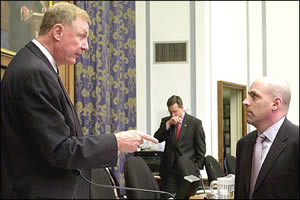
''We've got a dictatorial president and a Justice Department that does not want Congress involved...
Your guy's acting like he's king, ''
GOP Representative Dan Burton of Indiana (left) tells Carl Thorsen, a deputy assistant attorney general. (AP photo)
|
''You tell the president there's going to be war between the president and this committee,'' Dan Burton, the Indiana Republican who heads the House Government Reform Committee, told a Justice Department official during what was supposed to be a routine prehearing handshake.
''His dad was at a 90 percent approval rating and he lost, and the same thing can happen to him,'' Burton added, jabbing his finger and glaring at Carl Thorsen, a deputy assistant attorney general who was attempting to introduce a superior who was testifying.
''We've got a dictatorial president and a Justice Department that does not want Congress involved. ... Your guy's acting like he's king.''
The searing tone continued for more than four hours from Republicans and Democrats, liberals and conservatives. All objected to the order Bush signed Wednesday and made public yesterday. It claimed executive privilege in refusing to hand over prosecutors' memos in criminal cases, including an investigation of campaign-finance abuses, saying doing so ''would be contrary to the national interest.
|
|
|
|
|
|
|


 Add
GFP to your PALM via AvantGo
Add
GFP to your PALM via AvantGo  - 12/11/01