The Memorandum predicts an impending peak in Soviet oil production
"not later than the early 1980s" (the actual peak occurred
in 1987 at 12.6 million barrels per day, following a preliminary peak
in 1983 of 12.5 Mb/d). "During the next decade," the unnamed
authors of the document conclude, "the USSR may well find itself
not only unable to supply oil to Eastern Europe and the West on the
present scale, but also having to compete for OPEC oil for its own
use." The Memorandum predicts that the oil peak will have
important economic impacts: "When oil production stops growing,
and perhaps even before, profound repercussions will be felt on the
domestic economy of the USSR and on its international economic
relations."
The significance of the document requires some unpacking. First, we
must understand the historical context in which it appeared.
Oil production in the US had peaked in 1970, just a few years
earlier. This was arguably the most important economic event of the
past half-century: until then America was the world's foremost oil
producer; for much of the twentieth century it was also the world's
foremost oil exporter. American oil won both World Wars for the Allies
and made the US the world's richest and most powerful nation.
Meanwhile, throughout most of this same period the USSR remained the
world's second foremost oil-producing nation.
The American oil peak signaled the end of an era: from that point
on, the US would become increasingly dependent on imports - and this
dependence would entail serious costs, as became apparent with the
Arab OPEC oil embargo of 1973, which sent the US economy into a
tailspin.
Clearly, CIA
analysts in 1977 understood the importance of the American oil peak
and believed that a peak of petroleum production in the USSR would
have similar or even graver consequences for that nation.
This much is clear and undisputable. Less clear is what was done
with the information. Soon after assuming office in 1981, the Reagan
Administration abandoned the established policy of pursuing détente
with the Soviet Union and instead instituted a massive arms buildup;
it also fomented proxy wars in areas of Soviet influence, while
denying the Soviets desperately needed oil equipment and technology.
Then, in the mid-1980s, Washington persuaded Saudi Arabia to flood the
world market with cheap oil. Throughout the last decade of its
existence, the USSR pumped and sold its oil at the maximum possible
rate in order to earn foreign exchange income with which to keep up in
the arms race and prosecute its war in Afghanistan. Yet with markets
awash with cheap Saudi oil, the Soviets were earning less even as they
pumped more. Two years after their oil production peaked, the economy
of the USSR crumbled and its government collapsed.
Did the Reagan administration base its Cold War strategy on the CIA
study, in the expectation that a Soviet Union economically weakened by
oil depletion would collapse if pushed hard on other fronts?
That question is mostly of historical interest. But the Agency's
focus on the phenomenon of oil peaks has important implications for
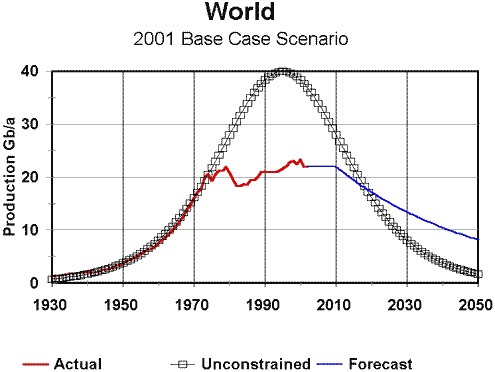
the present. For the past decade, oil experts have been debating when
global oil production will peak. Pessimists say the global peak may
already have occurred in 2000; optimists say it won't come until 2025
or so. A growing consensus of petroleum geologists places this pivotal
event in the mid-range period of 2006 to 2015.
From a certain perspective, the amount of time in dispute is not of
great significance: whether we have a year or two or a decade or two
before the supply of oil can no longer meet demand is relatively
trivial from a historical, analytical point of view (though of
considerable significance for billions of individual humans needing to
make plans for the years ahead); the result in either case will be the
same - a slow-motion global economic and industrial collapse.
The 1977 CIA document shows clear and detailed awareness of oil
issues, including depletion, extraction technologies, pipelines, areas
of likely new discovery, the quality of existing reserves, and the
dynamics of the global oil market. The CIA has obviously been studying
oil very carefully for some time and must therefore understand the
issue of global oil peak. This begs the questions: Does the Agency
have a strategy for dealing with this impending mega-event? Or is the
Agency's job merely to provide information, and allow the current
Administration to formulate policy?
Here we must speculate. The developing semi-public row between the
neoconservatives of the present Administration and CIA insiders
suggests that the Bush team's plan for invading Iraq and subsequently
redrawing the map of the Middle East may not exactly coincide with
Agency recommendations. We know that the Bush-Cheney team is
independently aware of the issue of peak oil because international oil
investment banker Matthew Simmons, who has written extensively and
forcefully on depletion issues, was an advisor to Vice President
Cheney's now-infamous Energy Task Force in 2001.
If policy makers and their intelligence analysts understand the
phenomenon of peak oil, and perhaps even used it strategically during
the 1980s to undermine the Soviet Union, and are aware of the upcoming
global peak, they must be interested to direct geopolitical events
accordingly. What thoughts may be occurring to them in this regard?
The Middle East boasts 70% of global proven reserves of oil. Saudi
Arabia has the world's largest reserves (25% of the total), and most
of the 9/11 hijackers are alleged to have come from that country.
Osama bin Laden is a Saudi native, and his published statements center
on the project of ejecting American influence from the nation of
Medina and Mecca.
If, as the neoconservatives have repeatedly hinted, Iraq is only
the first stage in a larger project of regional regime change, then
the real prize must lie just to the south in the giant fields east of
Riyadh. One cannot help but wonder if the long-coddled Saudi
government is even now being set up for a fall.
As events unfold, it will be of more than passing interest to see
whether the CIA and the Bush Administration reconcile their
differences, or whether the neoconservatives' hubris and ideological
monomania will be their undoing.
Meanwhile the real motives and long-term strategies of policy
makers and intelligence gatherers alike will likely remain opaque to
citizens who pay in blood and dollars for their government's military
adventures. "The Impending Soviet Oil Crisis" gives us a
rare, limited glimpse into the machinery of covert information
analysis and decision-making that shape history as we live it.
For sources, please check out informationclearinghouse.info
Related Sources:
PEA K OI L | Lecture
... 2. Sub-Title The title of my talk is Peak Oil. It truly is a turning point for Mankind. ... 5.
Discontinuity · As I said, peak oil is a turning point for Mankind. ...
energycrisis.org/de/lecture.html - 58k - Cached - Similar pages
ASPO the Association for the Study of Peak Oil
... THE ASSOCIATION FOR THE STUDY OF PEAK OIL&GAS A short summary of iwood2003 by Michael
C. Ruppert: Paris Peak Oil Conference Reveals Deepening Crisis May 30 ...
www.peakoil.net/ - 14k - Aug 15, 2003 - Cached - Similar pages
ASPO the Association for the Study of Peak Oil
... from a Bush Insider about Peak Oil and Natural Gas Depletion © Copyright 2003,
From The Wilderness Publications, www.copvcia.com. All Rights Reserved. ...
www.peakoil.net/iwood2003/MatSim.html - 47k - Cached - Similar pages
[ More results from www.peakoil.net ]
An MBendi Profile: World: Oil And Gas Industry - Peak Oil: an ...
An MBendi Profile: World: Oil And Gas Industry - Peak Oil: an Outlook
on Crude Oil Depletion - CJ.Campbell - Revised February 2002. ...
www.mbendi.co.za/indy/oilg/p0070.htm - 72k - Aug 15, 2003 - Cached - Similar pages
Hubbert Peak of Oil Production
Hubbert Peak of Oil Production. Bulletins, Submit articles to iNet News. ... Hubbert Peak
of Oil Production website... is powered by clean, reliable solar electrons. ...
www.hubbertpeak.com/ - 19k - Aug 15, 2003 - Cached - Similar pages
Peak oil: A turning point for humankind
... Peak oil: A turning point for humankind. by Colin J. Campbell. ... It's not a war for
oil? by Adam Khan. Peak oil: A turning point for humankind by Colin J. Campbell. ...
www.culturechange.org/issue19/peakoil.htm - 29k - Cached - Similar pages
Revealing Statements from a Bush Insider about Peak Oil and ...
Revealing Statements from a Bush Insider about Peak Oil and Natural Gas Depletion. ... Most
serious scientists worry that the world will peak in oil supply. ...
www.fromthewilderness.com/free/ww3/061203_simmons.html - 94k - Cached - Similar pages
[PDF]Peak Oil: A Turning for Mankind
File Format: PDF/Adobe Acrobat - View as HTML
... STUDIES M. KING HUBBERT CENTER Petroleum Engineering Department COLORADO SCHOOL OF
MINES GOLDEN CO 80401-1887 PEAK OIL: A TURNING FOR MANKIND Colin J. Campbell ...
hubbert.mines.edu/news/Campbell_01-2.pdf - Similar pages
Peak Oil: A Turning for Mankind; Colin J. Campbell
PEAK OIL: A TURNING FOR MANKIND. by Colin J. Campbell. The fundamental driver of
the 20th Century's economic prosperity has been an abundant supply of cheap oil. ...
www.greatchange.org/ ov-campbell,peakoil_turning_for_mankind.html - 14k - Cached - Similar pages
[DOC]THE ASSOCIATION FOR THE STUDY OF PEAK OIL
File Format: Microsoft Word 2000 - View as HTML
THE ASSOCIATION FOR THE STUDY OF PEAK OIL. &. ... The same calculations indicate
that world production of all conventional oil will peak in about 10 years. ...
www.asponews.org/docs/Newsletter16.doc - Similar pages
GFP-articles about Oil- Best of:
Russia Oil Company Say's 'Not So Fast there Smirky'
US Troops Take Control of 408 Oil Wells Around Kir
Food, Medicine, Water and Culture Can Wait, But Lo...
At Iraqi Oil Plant, Bitterness, Idleness
New Confirmation on real reason for Iraq war
US Admin appointed ex-Shell CEO for Iraq's Ministr...
Saudi Visit to Moscow Is Important
Waxman: Secret Contract allows Halliburton to prod...
EU-Commissioner Nielson: "US wants to appropriate ...
Iraqis Want U.N. to Control Oil Cash, Not U.S.
WMD: It was all a lie (Midland News)
Casablanca Attack -another Oil Industry Inside Job?
Halliburton secretly worked with DoD long time bef...
Top Pentagon Paper of '99: If an oil "problem" ari...
U.S. is after oil, Iranian asserts
Wolfowitz: Iraq war was about oil
Oil War: Explosion at Iraq Pipeline
Africa: Explosion On Oil Pipeline
Iraq-Israel oil pipeline 'to reopen'
Flow of Iraq Oil delayed
France-Congo "Conflict" - Coverup for War about Oil?
Next "War against Terrorism" in Africa?
Peak Oil- A summary by C.J.Campbell
(December 2000)
Poland confirmed "ultimate objective" in Iraq was Oil
GFP: War in Africa was planned for years
Cheney's "Iraq"-Task Force Story picked up by AP
Cheney's Oil Maps- Reason for Iraq war?
Chinas Oil Canal Project in Thailand
BP and Shell signed Iraqi Oil Contracts
Oil producers nervous about expected rise in supplies
Immunizing U.S. firms exploiting Iraqi oil
Peru Pipeline Loans postponed
Congress about Halliburton: Inside Track over Bechtel?
Executive Order for Oil Business in Iraq
Greek-Paki Oil Tanker accident
Kirkuk-Ceyhan Pipeline sabotaged
CIA's Interest in Peak Oil