|
|
|
|
 Deception Dollars  t-shirts Sections
911 Main
- About - GFP HOF - My GFP - Older Stuff - Past Polls - Submit Story - Video - mp3 - SGTV SGTV/INN
Watch SGTV, our TV show, every Thursday on MNN webcast, 8 PM EST
INN is also our new breaking news partner. Their news shows incl. Interview Highlights with John Pilger, Joe Conason, Michael Meacher, Bev Harris, Cynthia McKinney, Sander Hicks and many others... 911 Encyclopedia
Ewing2001 Has compiled a comprehensive list of links an articles pertaining to 911. This is required reading for anyone interested in understanding that horrid day ESPECIALLY since the presstitutes refuse to their job.
Mike Malloy pulls no punches with the FLYING MONKEY RIGHT. If you want to hear a REAL liberal tell it like it is don't miss his show! Listen Daily 9pm to 12pm One Year Later
Tune in to get a liberal helping of the TRUTH. Peter Werbe stands up to the neo-cons and for liberal cause daily while keeping us all informed on the daily events that are shaping our world. Listen Daily 2pm till 5pm
Liberal Talk Radio In Florida! Spread the word. Tell your friends to listen in. Call the station every Saturday and give them your supportive comments (239-732-9369). Call The Guy James Show live on the air (239-530-1660). The Randi Rhodes Show
Books
All Books
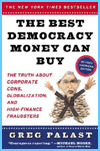
Greg Palast: Updated: with %40 more pages than the hard cover.
Alex Jones Video
Global Outlook
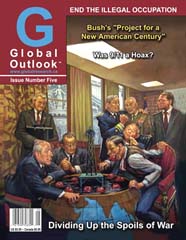
Michel Chossudovsky's Magazine on 911 and Post-911 Analysis Issue No.5-out now:Bush's "Project for a New American Century" Was 9/11 a Hoax? Diving up the Spoils of War Website Topics of the month: Was Kelly assassinated for "pulling the plug" The Forged Intelligence on Iraq Who's Who on the 9/11 "Independent" Commission Hot ranking thread: CIA closed friend with the finanzsystem of Al-Quida!
Counterpunch
|
What Happened to America? by Martin Schreaderposted by NYC on Saturday April 26, @02:06PM

  from the Politics dept.  Part Three of a Three Part Series A review of the rise of fascism to power in the United States By MARTIN SCHREADER Written: April 2-15, 2003 THE SUDDEN COLLAPSE of the Soviet Union and its sister states at the end of the 1980s and beginning of the 1990s threw the development of fascism in America into a crisis of its own. Anticommunism had been used hitherto as a political focal point for the emerging fascist movement. Only a few sectors of this new movement had begun to challenge openly the theoretical foundations of the bourgeois-democratic Enlightenment. Thus, the shift of sections of the ruling class in the direction of fascism was spiked, and the capitalist class was torn in two, between those looking at fascism as the only course and those who saw the potential for staving off crisis through renewed accumulation of capital. In a sense, it would be fair to say that "official Communism" was able to render one last service to the world's working class by committing suicide, thus splitting the world’s bourgeoisie (including the Americans) and making sections of them think twice about the program of the neo-conservative, fascist Right. However, the opening of the 1990s did not result in a kind of "people's front" system of government like the one we saw in France, Spain or the United States in the 1930s. Instead, the shift to the right continued, this time under political movements that had once been under the leadership of liberals and Social Democrats. Here is where neo-liberalism as a political ideology is given its legitimacy. For a capitalist class that had closely approached a "fascist consensus," but was saved by the collapse of the USSR and the Central European "people's democracies," the politics of neo-liberalism and "Third Way" Social Democracy were palatable forms of public policy. They were willing to accept it all, including the prolongation of social policies like "multiculturalism" and "political correctness," as long as they did not tie the hands of Big Capital during the new period of growth and accumulation. The steady rise in wealth among the ruling classes of the Great Power states (the "Group of Seven," or G-7: the U.S., Britain, France, Germany, Italy, Canada and Japan), accompanied by the new revolutionizing of production and distribution (the "Digital Revolution"), allowed many elements of the capitalist class to confidently step back from the abyss and once again place a measure of reliance on the forms of capitalist "democracy" to maintain social order. Even with the rise of even more violent and extreme fascist movements in the 1990s (e.g., the militia movement in the U.S., or the xenophobic anti-immigrant movements of North America and Europe), capitalism saw no real threat coming from the working class that would require such elements, and sought to keep them in check -- though they had no interest in completely removing them from the picture. As the 1990s drew to a close, the capitalists of the Great Powers were just beginning to see that the "bubble" they all rode to ever-dizzying heights of wealth and opulence was about to burst. In a theoretical sense, many of them knew the rising profits and sources of wealth and accumulation could not hold out forever. However, the capitalists were drunk with success, and were not prepared for the "morning after" when it came at the end of March 2000. It was at this moment that those capitalists who had been pushed aside at the beginning of the decade began to organize and prepare. They were perhaps the most aware of what was to come, because many of them were what could only be called the "old capitalists" -- that is, they were the owners and directors of that section of industrial and finance capitalism that had existed throughout most, if not all, of the 20th century. Continued.
Politically speaking, these capitalists had been prepared since the mid-1990s. Through Gingrich and his dominant faction in the Republican Party, they were able to make that party's machinery much more efficient and flexible, able to move quickly when the situation changed. It is not for nothing that Gingrich kept a portrait of the Russian Marxist Vladimir Lenin on his wall. It was not that Gingrich admired Lenin; rather, what Lenin represented to Gingrich, and his Republican co-thinkers, was the power that a centralized, relatively homogeneous political party could wield. This is why he attempted to impose, and partially succeeded in imposing, a kind of "democratic centralism" (in reality, though, a bureaucratic centralism of the Stalin type) on the Republican Party. The Republican Party was transformed from a general "umbrella" party for conservatives to a factional party, generally representing one political trend. It is in this context that we can better understand the fight between John McCain and George W. Bush during the Republican primaries. These two represented the internecine conflict between the old conservatives, who preferred to keep the Republicans as a relatively more open conservative party, and the neo-conservatives, who wanted the party to accept the more homogeneous formula. In such a primary fight, the party machinery plays a central role. With the party machinery either built or rebuilt by people associated, to one degree or another, with the neo-conservatives, it was clear who their choice was and no amount of appealing to the base would necessarily stop it. FOLLOWING THE END of the primaries, and especially the end of the Republican National Convention, the capitalists who fostered this development of fascism in the Republican Party now set out to cobble together their own coalition of forces outside the political structure. They began by pulling together a faction within the capitalist class. More or less, this was easy for them. Using the ties created through business relationships and the expansion of credit, they pulled in capitalists from nearly every sector of the economy, and bound their economic future hand and foot to the political fortunes of the Republican Party. Through their relations with large defense contractors, they also began to cultivate a relationship with key sections of the military apparatus. Many in the officer corps had been frustrated by the turn in the 1990s away from large-scale military build-up to smaller "peacekeeping" and police operations. These capitalists now made their own Faustian offer: stand behind us and we will give you new weapons, wars to fight and a secure future after retirement. (Well, two out of three anyway.) This alliance of capitalist CEOs, military officers and fascist politicians became crucial in the aftermath of the 2000 election, when the military came to the brink of rebellion over questionable absentee ballots. From here on, the history is generally well known. The night of the election saw powerful forces at work to make sure the election went their way. The sign that something was amiss became evident after many polling services declared that Al Gore had won the vote in Florida. Almost immediately, the Bush campaign staff sent a flurry of phone calls and e-mails to the media and the state government in Tallahassee. When the major media networks began to reverse their earlier statement and the statements of the polling services that were working in Florida, and placed the state in the "Too Close to Call" column, it was becoming clear that this election -- and, even though it was not perhaps immediately or consciously recognizable at the time, this country -- would turn out horribly different. Perhaps a telling sign of things to come was the staged riot at the Miami-Dade County Courthouse in late November 2000. At the time, this riot was presented in the media as a spontaneous outpouring of anger and frustration over the process of manually counting the ballots in that county. It was not until much later, after Bush had been installed as the chief executive, that we learned the rioters were in fact paid operatives and staff members of the Republican Party machine. This extralegal riot succeeded in permanently shutting down the process of counting the ballots, and thus nullifying the votes of tens of thousands of votes in that county. Combined with numerous instances of police intimidation and harassment of voters in Florida, Michigan, Virginia and other states, and the systematic purge of African American voters from the rolls in Florida (and, it is rumored, other states), the scene of a bloodless coup d'état takes shape. The "one-time-only," narrow decision by the Supreme Court of the United States to install Bush in the White House codified this coup, and attempted to lend it an air of Constitutional legitimacy. The American people were being dragged into fascism kicking and screaming. It was obvious that the majority of the people in this country did not favor the agenda being imposed upon them from above. However, they were left without any viable alternative in terms of political direction and organizational expression. This was finally confirmed when the Democratic members of the Senate, acting under pressure from the DLC (and, behind them, the same capitalists that also bankrolled the Republicans), ignored the pleas of their own African American members in the House of Representatives and signed off on the Florida vote. This final betrayal by the Democratic members of Congress, reflecting the political position of the leading circles of the party, finally exposed broad sections of the population to the fact that there was no section or wing of the capitalist class willing to defend even the limited democracy that existed before 2000. With the path clear, except for a nascent and not yet fully organized political movement for democratic rights that posed no serious threat, -- or, as in the case of Jesse Jackson, had surrendered the fight out of fear of losing his privileges -- the new Bush regime now began to implement those elements of its agenda that it could get away with at the time. Most of these were centered on a fundamental shift in the economic distribution of wealth and financial base of the state. In the past, the American capitalist state functioned based on graduated taxes, with those who make more paying more proportionally, and that aggregate amount of money being distributed among the various programs. Now, under the Bush regime, a new message was sent to the people, mainly working people: the rich can take care of their own needs out of their own pocket; if you want services like sanitation collection, protection from crime, unemployment insurance, etc., expect to pay for it all yourselves. This was the principle guiding the restructure of the tax system. Shifting the economic base was but only one aspect of the Bush regime's agenda. With the onset of the economic recession, these capitalists knew the only way they could continue to keep their profit margins from stagnating and eventually declining was to squeeze the working class, to bleed it dry by extracting more surplus value from their labor, by shifting the public burden (that is, the burden of financing the state) on to workers' shoulders and by making any kind of opposition to such rampant exploitation impossible. Thus, the economic measures alone were not enough; the democratic rights of the American people, as outlined in the Constitution, Bill of Rights and federal law, had to be overturned, abridged or otherwise nullified. Taking care of the federal enforcement provisions of democratic rights was the easy part. The Supreme Court of the United States was more than willing to take the role of "Supreme Legislator," and repeal those sections of the law that allowed for the enforcement of basic democracy. However, it would take a cataclysmic event -- relatively unprecedented in American history -- to generate mass support for overturning the Constitutional provisions guaranteeing democracy. That event came on the morning of September 11, 2001. "THESE ARE THE premises for a swift formation of a fascist party and its victory," Trotsky writes in his last line of the above quoted passage. This of course raises an immediate question: How swift is "swift?" Certainly, the process we discuss here spans close to 40 years of historical development. Is 40 years a "swift" period of time? From the perspective of the individual human being, 40 years can seem like a lifetime (or more than a lifetime, as in the case of this author). However, from the perspective of historical development -- the "long view" of history -- 40 years is nearly a blink of the eye. Relativity of the Einstein variety is not reserved solely for the realm of physics. The relationship between the laws of motion and relativity have as much place in understanding the movement of history and society as they do in the movement of atoms or celestial bodies. Viewing the rise of fascism in the United States from the standpoint of the long view of history allows us to understand better the meaning behind Trotsky's comment in the first paragraph, quoted above: "Insofar as the proletariat proves incapable at a given stage of conquering power, imperialism begins regulating economic life with its own methods." The government campaigns of the last four decades of the 20th century for "empowerment" -- beginning during the so-called "War on Poverty," and accelerating through the 1970s and 1980s to the period of "welfare reform," represented, to one degree or another, an attempt at social regulation of the poorest and most oppressed sectors of society. These campaigns, which even deceived many ostensible "socialists," were, in the final analysis, attempts by the capitalists to regulate and regiment society from above, "with its own methods." With social regimentation in place, with the economic burden sufficiently shifted to stave off ruin for those sections of the capitalist class that sponsored the rise of the Bush regime, the American ruling class was confronted now with another, seemingly insurmountable problem. For the last decade, world capitalism had integrated itself to an unprecedented degree. Primarily nationally based modes of production had given way to a worldwide system of production, distribution and exchange -- commonly referred to as "globalization." At the same time, though, globalization had also drawn and bound together workers around the world, and they now were beginning to act in a coordinated way on an international scale. The contradiction between the world market and national boundaries was reaching a breaking point. This contradiction was accentuated by the fact that many of those elements of the American capitalist class that had sponsored the takeover by the Republican Party had been on the short end of many of the deals and agreements that came out of globalization. Something had to give. The first manifestations of how the new regime at the head of the United States was going to resolve this contradiction became apparent in the first months after Bush took power. The withdrawal from the Kyoto Accords was only the first sign that, for the new regime, when confronted with the choice between the nationalist appetites of American capitalism and the world market, "America first" -- or, more to the point, on America's terms "first." Over the next year, the United States would also pull out of the Anti-Ballistic Missile treaty with Russia (signaling a desire for rearmament) and the treaty governing the International Criminal Court (a key accord mandated in the United Nations Charter). "Unilateralism" became the buzzword to describe the new ideology governing America. Trotsky, who had already once declared his opinion that he believed the U.S. would at some point seek to "organize the world," and perhaps sensing things to come, summed up the "unilateralism" of a fascist state this way: "The totalitarian state, subjecting all aspects of economic, political, and cultural life to finance capital, is the instrument for creating a supranationalist state, an Imperialist empire, ruling over continents, ruling over the whole world." Can we say with full confidence that the United States is an "Imperialist empire," as he puts it? Based on the events since Sept. 11, 2001, and the wars in Afghanistan and Iraq, one could certainly conclude that, if anything, this country is taking the first steps on that road -- a road that ends inevitably at the outbreak of a Third World War. However, there is much more that must happen for this protracted fascism we see in the United States to achieve its empire and a new "Pax Americana" -- a new "American Century." Many more wars, including wars with rival imperialist powers like France and Germany (or their proxies), will have to be waged to clarify the situation. However, one thing is certain: barring an uprising and democratic revolution, the road to an Imperialist empire is clear and open. Not even a relatively peaceful change at the head of the regime, or the state, can alter its path in any meaningful -- to say nothing of fundamental -- way. SOMEONE ONCE SAID that the Iron Heel of fascism has always aimed for America, but usually fell in Europe. Today we deal with a mind and body attached to that Iron Heel that is older and wiser, which has learned from its mistakes -- and its enemies -- and has been able to craft a finely-tuned agenda and program that has successfully broken 225 years of democratic tradition. The revolutionary ideals of "Life, Liberty and the Pursuit of Happiness" have been discarded in favor of willful ignorance, malign neglect and institutional misery. The principles of the Enlightenment now sit shrouded in a sea of hateful vengeance. Peace and prosperity are sacrificed on the altar of brigandage and social barbarism. The curtain has fallen, and all that remains are the deep echoes of hard-worn soles on crumbling roads.
And this is America.
This is America. End of Part Three of a Three Part Article by Martin Schreader.
< MI5/CIA: Evidence on Iraq was fabricated | Exclusive Interview with Ben-Veniste, Commissioner on 9/11 > |
Global Free Press Login
Related Links
| ||||
|
||||||
|
[ home | contribute story | older articles | past polls | faq | authors | preferences ]
FAIR
USE NOTICE: This
site contains copyrighted material the use of which has not always been
specifically authorized by the copyright owner. We are making such material
available in our efforts to advance understanding of environmental, political,
human rights, economic, democracy, scientific, and social justice issues,
etc. We believe this constitutes a 'fair use' of any such copyrighted material
as provided for in section 107 of the US Copyright Law. In accordance with
Title 17 U.S.C. Section 107, the material on this site is distributed without
profit to those who have expressed a prior interest in receiving the included
information for research and educational purposes. For more information
go to: http://www.law.cornell.edu/uscode/17/107.shtml
If you wish to use copyrighted material from this site for purposes
of your own that go beyond 'fair use', you must obtain permission from the
copyright owner.
Powered by daVinci Interactive and Slashcode
 Add
GFP to your PALM via AvantGo
Add
GFP to your PALM via AvantGo
Add GFP HeadLines to your site XML
or RDF
Questions or Comments
Regarding This Site
webmaster@globalfreepress.com