|
|
|
|
 Deception Dollars  t-shirts Sections
911 Main
- About - GFP HOF - My GFP - Older Stuff - Past Polls - Submit Story - Video - mp3 - SGTV SGTV/INN
Watch SGTV, our TV show, every Thursday on MNN webcast, 8 PM EST
INN is also our new breaking news partner. Their news shows incl. Interview Highlights with John Pilger, Joe Conason, Michael Meacher, Bev Harris, Cynthia McKinney, Sander Hicks and many others... 911 Encyclopedia
Ewing2001 Has compiled a comprehensive list of links an articles pertaining to 911. This is required reading for anyone interested in understanding that horrid day ESPECIALLY since the presstitutes refuse to their job.
Mike Malloy pulls no punches with the FLYING MONKEY RIGHT. If you want to hear a REAL liberal tell it like it is don't miss his show! Listen Daily 9pm to 12pm One Year Later
Tune in to get a liberal helping of the TRUTH. Peter Werbe stands up to the neo-cons and for liberal cause daily while keeping us all informed on the daily events that are shaping our world. Listen Daily 2pm till 5pm
Liberal Talk Radio In Florida! Spread the word. Tell your friends to listen in. Call the station every Saturday and give them your supportive comments (239-732-9369). Call The Guy James Show live on the air (239-530-1660). The Randi Rhodes Show
Books
All Books
Greg Palast: Updated: with %40 more pages than the hard cover.
Alex Jones Video
Global Outlook
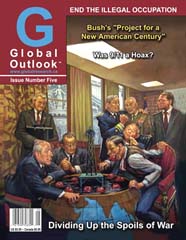
Michel Chossudovsky's Magazine on 911 and Post-911 Analysis Issue No.5-out now:Bush's "Project for a New American Century" Was 9/11 a Hoax? Diving up the Spoils of War Website Topics of the month: Was Kelly assassinated for "pulling the plug" The Forged Intelligence on Iraq Who's Who on the 9/11 "Independent" Commission Hot ranking thread: CIA closed friend with the finanzsystem of Al-Quida!
Counterpunch
|
Ex-Porton Down Scientist: "'Weasel words' over Iraq"posted by ewing2001 on Thursday June 19, @12:53AM

  from the BBC dept. 
UK's 'weasel words' over Iraq18 June, 2003 A top UK scientist has accused the government of "weasel words" in its dossiers about Saddam Hussein's weapons capability. Dr Thomas David Inch, who used to work at the UK's biological and chemical weapons establishment at Porton Down, told MPs that he could not understand why weapons of mass destruction have not been found in Iraq. Giving evidence to the Commons foreign affairs select committee' inquiry into the UK's decision to go to war with Iraq, Dr Inch questioned the quality of the intelligence used in a dossier that claimed Saddam Hussein could launch a strike in 45 minutes.
He said it would be very difficult to move chemical and biological weapons or to conceal their manufacture without leaving traces. The pressure on Tony Blair over the weapons issue prompted George W Bush to insist that charges the UK government exaggerated the Iraq threat were "simply not true". The US president took time out from discussion on American health reforms to say: "[Tony Blair] operated on very sound intelligence, and those accusations are simply not true." Dr Inch's evidence followed the appearance of Robin Cook and Clare Short before the inquiry on Tuesday. 'Extraordinary' The Foreign Office's former political director Dame Pauline Neville-Jones also gave evidence on Wednesday saying that it was "extraordinary" weapons of mass destruction had not been found in Iraq. Dame Pauline said that though she thought the prime minister had sincerely believed the claim that Saddam could launch a chemical or biological strike within 45 minutes, she questioned the reliability of the intelligence behind it. "I think that it is so extraordinary not yet to have found any weapons of mass destruction," she said. "I do think questions have to be asked, for reasons nothing to do with the integrity of the people involved - was the intelligence after so many years when we had not had inspectors in there somehow off beam?" she said. Former cabinet minister Mr Cook accused Mr Blair's government of "not presenting the whole picture" in the run-up to war with Iraq. Fellow ex-minister Clare Short also gave evidence in which she accused the prime minister of a "series of half truths, exaggerations, reassurances that weren't the case" in the run-up to war. Related Sources: Oral evidence Taken before the Foreign Affairs Committee on Tuesday 17 June 2003 Memorandum submitted by Mr Robin Cook, MP Mr Cook: The full paper has been circulated to the Committee. I set out in that paper the cluster of five questions which I think it would be helpful for the Committee to address. Firstly, why is there such a difference between the claims made before the war and the reality established after the war? Much of that is not going to change with any more period of time. We have found no chemical production plants. We have found no facilities for a nuclear weapon programme. We have found no weapons within 45 minutes of artillery positions. Those are not going to change however much more time is now given. Secondly, did the Government come to doubt these claims before the war? It is very well known that the State Department came to have doubts in February. Did they share those doubts with us? It is interesting that those key claims in the September dossier were not actually repeated in the March debate. Had the Government itself come to lose confidence in them? If so, should it not have corrected the record before the House voted? Thirdly, could biological or chemical agents have fallen into the hands of terrorists since the war? One of the points that was made very strongly, particularly in the March 18 debate, was the danger that such material would pass to terrorist organisations? If they existed in Iraq at the time of the war, they have existed for the past two months unguarded and unsecured, which is very alarming. Is there any clarity that that material has now not passed into the hands of terrorists? Fourthly, why do we not allow the UN Weapon Inspectors back into Iraq? I find it difficult to avoid the conclusion the reason we do not is because they would confirm Saddam did not have an immediate threatening capability. Lastly, does the absence of weapons of mass destruction undermine the legal basis of the war? The opinion of the Attorney General is entirely on the justification for war being the need to carry out the disarmament of Saddam Hussein. If he can find no weapons to disarm does that legal opinion still have basis? Finally can I just say, Chairman, reading the record it is striking that the Foreign Office and Mr Straw were more cautious in the statements that they made in the run-up to the war. I understand that your inquiry is looking at the Foreign Office in the context of the Government as a whole but, in fairness to the Foreign Office, I hope it will be acknowledged that they did exercise care in what they said. ... Q68 Mr Hamilton: Did you believe that there was a threat to British interests posed by Iraq prior to 11 September 2001? Clare Short: No, I did not believe that. I believed that the people of Iraq were suffering badly and that Saddam Hussein was in defiance of the UN over the question of working to try to achieve chemical and biological weapons. I believed and I still believe that he did try nuclear, but the previous inspection regime dismantled that, so I still do not think he was an imminent threat. I think that is where one of the exaggerations came, but I think he was, and I believe still, that he was committed to having laboratories and scientists and doing work and trying to develop chemical and biological weapons, and we know that he had ballistic missiles of a range beyond that permitted in the Security Council Resolution. My view was that the problem needed attending to, but that there was not an imminent threat and, therefore, we should do it right. The new urgency which came into the US was because of September 11, and this false suggestion that there was any link to al-Qaeda is another of the falsities to try to get an urgency for that, so I think the right way would have been to say, "We are going to attend to this and we are going to attend to the Middle East". The Road Map had already been negotiated, so we should have started off with publishing that and started implementation and showing a commitment to move to justice in the Middle East and then we should have turned to Iraq, trying to keep the support of Arab governments, and we should have tried for disarmament and we could have even had the UN authorised military action to support the inspectors, it seems to me. We should have tried indicting Saddam Hussein and we should have lifted sanctions. If you take the Kosovo parallel, and I was one who believed that we should have acted on Milosevic earlier with all the ethnic cleansing from Bosnia and so on, but it was absolutely right to act and the Kosovars being pushed out of their country was reversed and then the military action stopped, but he was indicted and other action was taken and we got him to The Hague without a full-scale invasion of Serbia. I hope that is not too long an answer, but the point is that I was very aware of it. My deepest concern was the suffering of the people of Iraq and the anger that was causing in the Middle East and I think it should have been attended to, but we had time to attend to it right. Let me make it clear that from the beginning of this crisis, and indeed before, I have always thought that we had to be willing to use military force to back up the authority of the UN, so I was not saying, "No military force at all at any price", but I was saying that we should avoid it if at all possible and that is the teaching on the just wall and you have to make sure that there is no other way, and we should have tried that. I thought for a long time in this crisis that the UK was playing the role of trying to restrain the US and trying to examine all other means, and I now think that we were not and that we pre-committed. Witness: DR THOMAS DAVID INCH, OBE, Former Deputy Chief Scientific Officer, MoD at Porton Down and former Chief Executive of the Royal Society of Chemistry, examined. Dr Inch: Can I give a kind of disclaimer at the start? I have had no direct links with Porton or the intelligence community for about 15 years. So everything that I say is kind of public record material and common sense deduction. It is not quite true that I have not spoken to some of the people at Porton because I am still involved in the Royal Society working party on decontamination and detection in regard to anti-terrorist issues. As chairman of the advisory committee to the National Authority on the Chemical Weapons Convention, I deal, from time to time, with chemical weapons convention issues. But I have no direct links in terms of the intelligence on the Iraq situation. Q212 Chairman: That is the disclaimer? Dr Inch: That is the disclaimer. I think you have to take the information in the dossier very much with a pinch of salt. The intelligence behind the dossier may be quite good, but I think that my interpretation of what is written raises more questions than answers. In many general terms that reflects some of the problems of making good technical assessments of the bits and pieces of intelligence information that comes your way. Sometimes the scientific community is in agreement with the intelligence community; and sometimes the scientific community disagrees strongly with the intelligence community's assessments. Perhaps I can give two historical examples as it is important to understand this. In the early 1970s the US intelligence community reported that there had been an accident in Sverdlovsk in Russia and that there had been an accidental release of anthrax from which many people had died. At that time in the US the chief scientific adviser was not convinced by the intelligence information; he did not think that it all held together. The signs and the symptoms did not fit the intelligence report. After the Iron Curtain came down that same person went to Sverdlovsk and was able to make a thorough interpretation. The scientific community had missed one or two important facts and the intelligence community was absolutely right. The total picture that emerged post-event was very convincing. That is one plus to the intelligence community. Rolling on to the early 1980s, the US intelligence community claimed that a new form of toxic material - T2 toxin - was being used in Laos in Cambodia which was subsequently dubbed "yellow rain". The American intelligence community went public at that time, and the information reached the Secretary of State and the President of the United States who went public on that information. Subsequently there was enormous pressure on our intelligence community to support the arguments. In this country our scientific community was never convinced; nothing really held together; the materials in question were insufficiently toxic; and there was a whole raft of other information that just did not fit. ... Dr Inch: On page 18 of the report at paragraph 3 it says that the intelligence suggests that: "These stocks would enable Iraq to produce significant quantities of mustard gas within weeks and of nerve agent within months". From a technical perspective I find it very difficult to understand unless the intelligence was very firm, very clear and very precise why it should be possible to make mustard gas within weeks but it would take months to make nerve agents. If you have the facilities in place, the previous knowledge and so on, and the plants available, it does not seem to me that it takes more time to make one than the other. The question is: how good was the intelligence? That would be the kind of question that I would wish to probe to find out whether it was hard or soft material that we are looking at. There are other examples. ... Dr Inch: First, I shall comment on the stability. Some chemicals are obviously more stable than others. There are problems, mainly with something like VX, but the other materials are fairly stable and I would have thought that they would have been stored and stabilised in adequate conditions. That is not a problem. Q217 Mr Chidgey: What would those conditions be? Dr Inch: To illustrate the point, the two countries with the big weapons stocks are the US and the old Soviet Union. Under the chemical weapons convention both countries are committed to destroying those stocks. It is going much more slowly than anticipated because of safety concerns. It will be 10 or 12 years before those stocks can be destroyed. Clearly, there is no real problem with the stability of them. They will not be in the same high quality as when they started, but they will still be very effective weapons stocks. That is the situation, I think, with anything held in Iraq. Q218 Mr Chidgey: How easy would it be to be absolutely sure that the storage facility was precisely the facility for chemical or biological weapons? Could it readily be mistaken or disguised as something else? Dr Inch: You asked about production as well and how easy it is to transfer from a civil to a military use. In recent years there has been a major change in manufacturing technology in the chemical industry. One still has the enormous petrochemical type complexes which are very dedicated to making one material by continuous procedure. But the pharmaceutical industry, for example, which also makes highly potent compounds, is in the mode of just-in-time synthesis. They make a few tonnes of material and then quickly move to something else. It is the same in a lot of industries these days; the equipment is designed to be flexible and used in a wide variety of ways. Once upon a time, when health and safety concerns around the world were not very important, one could probably detect a plant making a highly toxic material by the extra safety precautions. In the modern world everything is governed by very tight safety regulations and it becomes increasingly difficult to judge whether a plant is making something that is highly toxic or something that may just be toxic. Q219 Mr Chidgey: Does that kind of health and safety regime apply to Iraq? Dr Inch: It is pretty general industrial practice and the kind of equipment and so on is readily available and may be bought. It is the kind of engineering practice that gets into the culture. One could still go against that, but the point I am making is that for many of the compounds involved there would be no difficulty in switching from one form of manufacture to another. Can I give you one other example because I think it makes the point very clearly? Under the chemical weapons convention, there are scheduled chemicals which are the highly toxic ones, and there is another class of chemicals called discrete organic chemicals which are also banned under the convention. The real inspection regime for those materials is only now getting under way. But I think that the OPCW inspectors in The Hague believe that about 30 per cent of the plants that they see worldwide, making discrete organic chemicals for perfectly legal purposes, have the capability to be modified very rapidly to make chemical warfare agents. Q220 Mr Chidgey: My question on that particular point is whether, due to the way in which you describe the situation, we should not talk about dual-use facilities, but about multi-use processing facilities. In other words, the plants that you describe could do any number of things one of which is producing chemical weapons. Dr Inch: One has to be a little careful. Dual-use chemicals are things like phosgene or hydrogen cyanide, in the kind of definitions that are highly toxic in their own right and could be used as a chemical warfare agent, although maybe not too effectively, whereas the facilities - you are absolutely right - are multi-purpose facilities rather than dual-purpose facilities. Q221 Mr Chidgey: Given that situation, if you were in the position of trying to define whether or not Iraq was operating a chemical weapons warfare programme and you were presented with a site that was a pharmaceutical chemical complex, what would you be looking for? Clearly the plant itself is not sufficient evidence to say that it is definitely a processing plant for chemical weapons. Dr Inch: Personally, I would have given as much attention to carrying out some environmental analysis on the plant as I would to the facilities, given the situation in Iraq. We read in the report that they have gone to great lengths to hide things. I do not believe that you can hide the fact that you had been making some toxic chemicals on that site. If a site had been declared as a chemical weapons producing site, or if the original inspectors at the end of the Gulf War knew it was a site, you would not find out the information, but if there was intelligence pointing to quite new production facilities that were being denied as production facilities by the Iraqis, then I believe that the trace analysis and so on of certain residues would probably give confirmation of whether or not that was a correct statement. Q222 Mr Chidgey: On that basis, what is your view of the assessment that Iraq was continuing to produce chemical and biological weapons after the inspectors left in 1998? Dr Inch: I have to say that I have no view. I do not think that there is any compelling evidence to say that they did, but again there is no compelling evidence to say that they did not. You really need to make a close inspection of the data available. Q223 Mr Chidgey: Do you have a view on the assessment that Iraq had a usable chemical and biological weapons capability in breach of UN Security Council resolutions, which has included the recent production of chemical and biological agents? Dr Inch: I have no view. I think you really need to judge the data. There are some other statements on the dual-use facilities. It says: "New chemical facilities have been built, some with illegal foreign assistance". Again, that is talking about the import of precursors and so on. I would have thought that that evidence needed to be pretty hard if it exists, and it should be quite clear. Under the various UN embargoes and under the chemical weapons convention now signed by over 150 countries and under the terms of the Australia group regulations, which is the western group which embargoes supplies of materials and products, Iraq would definitely be a "no go" area for any of those materials from any respecting western government. Under the convention it is the responsibility of national governments to ensure that there are no exports to places like Iraq. Otherwise the treaties and so on are not being properly implemented. Future Public Meetings Thursday 19th June 2003: 11.00am in the Wilson Room, Portcullis House Witnesses: Mr Andrew Gilligan, BBC Defence Correspondent, and Mr Mark Damazer, BBC Deputy Director of News Thursday 19th June 2003: 2.30pm in the Grimond Room, Portcullis House Witnesses: Mr Andrew Wilkie, former Senior Intelligence Adviser to the Australian Prime Minister; at approximately 3.30pm, Dr Ibrahim al-Marashi, Research Associate at the Centre for Non-Proliferation Studies. Tuesday 24th June 2003: 12 Noon in the Boothroyd Room, Portcullis House Witnesses: Rt Hon Jack Straw MP, Secretary of State, and officials, Foreign and Commonwealth Office. Tuesday 24th June 2003: 3.00pm in the Grimond Room, Portcullis House Subject: FCO Annual Report 2003 Witnesses: Sir Michael Jay KCMG, Permanent Under-Secretary of State, Mr Peter Collecott CMG, Director General, Corporate Affairs, Mr Simon Gass CMG, Director, Resources, and Mr Alan Charlton CMG, Director, Personnel, Foreign and Commonwealth Office Friday 27th June 2003: 9.00am in Committee Room 13 – Not open to press or public Witnesses: Rt Hon Jack Straw MP, Secretary of State, and officials, Foreign and Commonwealth Office.
< Did Bush ask for advice? Prez met ex-Watergate Con | 911 -Early Warnings: Sabotaged FBI Agents and their Fate > |
Global Free Press Login
Related Links
| ||||
|
||||||
|
[ home | contribute story | older articles | past polls | faq | authors | preferences ]
FAIR
USE NOTICE: This
site contains copyrighted material the use of which has not always been
specifically authorized by the copyright owner. We are making such material
available in our efforts to advance understanding of environmental, political,
human rights, economic, democracy, scientific, and social justice issues,
etc. We believe this constitutes a 'fair use' of any such copyrighted material
as provided for in section 107 of the US Copyright Law. In accordance with
Title 17 U.S.C. Section 107, the material on this site is distributed without
profit to those who have expressed a prior interest in receiving the included
information for research and educational purposes. For more information
go to: http://www.law.cornell.edu/uscode/17/107.shtml
If you wish to use copyrighted material from this site for purposes
of your own that go beyond 'fair use', you must obtain permission from the
copyright owner.
Powered by daVinci Interactive and Slashcode
 Add
GFP to your PALM via AvantGo
Add
GFP to your PALM via AvantGo
Add GFP HeadLines to your site XML
or RDF
Questions or Comments
Regarding This Site
webmaster@globalfreepress.com