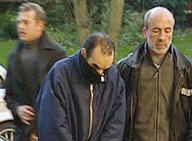
According to prosecutors, Mzoudi’s Hamburg apartment served as the meeting place of a group of Islamic radicals who, bound by a common hatred for the United States and Jews, planned an attack that would shock the world. The apartment was referred to by the men as Dar al Ansar, or “House of the Followers.” Tellingly, this name was also given to the Peshawar office used by Osama Bin Laden as a safe house for fighters who were traveling to Afghanistan during the 1980’s to wage jihad against the Soviet Union.
After countless meetings at Mzoudi’s apartment, some members of the Hamburg cell went to the United States to attend flight schools and carry out the lethal 9/11 plan; others remained in Hamburg providing logistical help. Prosecutors assert that while the men who worked from Germany may not have known every detail of the plot, they were well-aware of the fatal intentions of their U.S.-based cohorts. For instance, Mounir Motassadeq allegedly told a friend, “[The 9/11 hijackers] want to do something big. The Jews will burn and we will dance on their graves.”
Mzoudi helped facilitate this murderous scheme by allowing Mohammed Atta and Marwan al-Shehhi, pilots of the planes that hit the Word Trade Center, to use his Hamburg apartment address. This arrangement enabled Atta and al-Shehhi to conceal their real whereabouts while they traveled to Afghanistan and applied to flight schools in the U.S. Al-Shehhi also used Mzoudi’s address on a new passport issued him by his native United Arab Emirates after he claimed to have lost his original one. This tactic is used frequently by terrorists to conceal visits to Afghanistan.
Mzoudi played a substantial role in the financial structure of the Hamburg cell, sending money, for example, to al-Shehhi while al-Shehhi attended flight schools in the United States. In addition, Mzoudi managed the finances of Hamburg cell member Zakariya Essabar as Essabar trained in an Al-Qaeda camp in Afghanistan (Mzoudi himself attended an al-Qaeda training camp near Kandahar in 2000). Incredibly, even as Mzoudi managed the accounts of men responsible for the largest terrorist attack in U.S. history, he received funding from the University of Hamburg’s Student Center.
The difficulty faced by German prosecutors in the case of both Mzoudi and Motassadeq lies in the fact that two were facilitators, sending money and providing apartments to terrorists but not actually carrying out terrorist acts themselves. Indeed, the lawyers for both men have argued that their clients believed they were simply helping fellow Muslims. When asked why he wired money to al-Shehhi, Motassadeq explained: “I’m a nice person, that’s the way I am.” Mzoudi claims he knew members of the Hamburg cell only casually and had no knowledge of their violent intentions.
According to Mzoudi’s indictment, the Hamburg cell was composed of eight men: the three pilots (Atta, al-Shehhi and Jarrah); a would-be pilot (Ramzi Binalshibh) who later bragged of having masterminded the operation in an interview with Al-Jazeera television; and four facilitators (Bahaji, Essabar, Motassadeq and Mzoudi). But recent arrests prove that others who had close contacts to the cell were involved in terrorist activities as well.
In March, Italian police arrested several men accused of forming a cell that provided material support to Ansar al-Islam, an Iraqi-based group linked to Al-Qaeda. One of the men, a Moroccan named Mohammed Daki, was interrogated by German authorities in the aftermath of 9/11 for his ties to several of the hijackers. Daki, who attended the same university as Motassadeq and Bahaji, worshipped at the al Quds mosque, a site frequented by members of the Hamburg cell. Daki also allowed Ramzi Binalshibh to use his address in papers filed with the German government in 1997.
Although Daki’s role closely resembles that of Motassadeq and Mzoudi, for reasons yet to be explained German authorities have decided not to indict him. Still, suspicions over Daki’s role in the Hamburg cell remain. In 1999, as members of the Hamburg cell were applying for visas, Daki was granted a student visa of his own at the U.S. Embassy in Berlin. Needless to say, American authorities are eager to learn the real purpose of Daki’s visa.
Daki was just one of several men living in Hamburg during the late 1990’s who crossed paths with the 9/11 hijackers. Some, like Binashibh and Mohammed Zammar, the Syrian believed to have recruited the hijackers, have been caught. Others like Essabar and Bahaji, both wanted by German authorities after fleeing to Pakistan a few days before the 9/11 attacks, are still at large. Disturbingly enough, some are still living as free men in Germany. An example is Mamoun Darkazanli, whose al-Qaeda ties date back to the mid-90’s. Despite Darkazanli’s business dealings with several al-Qaeda operatives, authorities have never been able to make a case against him.
Considering the recently published Congressional Report on the 9/11 attacks, which states that “legal barriers restricted Germany’s ability to target Islamic fundamentalists,” German prosecutors’ failure to indict Darkazanli comes as no surprise. But American efforts to infiltrate the Hamburg cell were equally disjointed. The Congressional Report shows that on several occasions the F.B.I. and C.I.A. unknowingly operated against the same targets.
Shockingly, the F.B.I. legal attaché in Germany did not recall getting information about Darkazanli and Zammar from either the German government or the C.I.A. before 9/11. He was also unaware that both men had been the subjects of investigations before the attacks. Another opportunity to expose the plot was missed in March of 1999, when the C.I.A. received intelligence about a student living in Germany named Marwan who had been in contact with both Zammar and Darkazanli. Closer communication with other U.S. agencies as well as German authorities may have helped the C.I.A. to understand that “Marwan” was actually 9/11 hijacker Marwan al-Shehhi.
While the Patriot Act has enabled the U.S. to greatly expand its intelligence capabilities and begin rectifying past mistakes like the al-Shehhi fiasco, partial changes to Germany’s counterterrorism laws have had little effect. This legislative failure, combined with systematic political correctness, ensures that Germany will remain a safe haven for Islamic radicals.
Abdelghani Mzoudi signed also Atta's "last will"!
Mzoudi's final Interview (german) before he was "silenced"
Belegstellen für »Mzoudi« am 10.05.2003
- Abdelghani Mzoudi, 28, kannte sämtliche mutmaßlichen Terroristen aus Deutschland persönlich.
- SPIEGEL ONLINE: Herr Mzoudi, Sie haben Attas Testament unterschrieben, haben Sie nie etwas von dessen Terrorplänen geahnt?
- Mzoudi: Nein.
- Mzoudi: Wir trafen uns in der Bibliothek der Universität.
- Mzoudi: Das liegt auch an unserem Glauben.
- Mzoudi: Manchmal habe ich ihn wochenlang nicht gesehen.
- Mzoudi: ...weiß ich sehr wenig.
- Mzoudi: Als Minderheit, vor allem wenn man betet, trifft man sich schnell.
- Mzoudi: Streng, den Begriff kann ich nicht mehr hören.
- Mzoudi: Richtige Gesprächskreise gab es nicht.
- Mzoudi: Ich habe in der gleichen Wohnung gelebt wie Atta und die anderen.
- Mzoudi: Er wirkte schwach, nicht gefährlich.
- Mzoudi: Er war so eine Art Vermittler zwischen uns und dem Vermieter.
- Mzoudi: An meinem ersten Tag an der Uni fragte mich ein Deutscher: "Was planst du? Einen Anschlag?"
- Generalbundesanwalt Kay Nehm hat am Freitag vor dem Hamburger Staatsschutzsenat gegen den Marokkaner Abdelghani Mzoudi Anklage erhoben.
- Mzoudi sei Mitglied der so genannten Hamburger Zelle um Mohammed Atta gewesen, die als Teil des Al-Qaida-Netzwerkes "selbstständig, nach außen abgeschottet und konspirativ" an der "Planung, Vorbereitung und Durchführung der Anschläge" mitgewirkt habe.
- Nach der Flugausbildung Attas, Al Shehhis und Jarrahs habe Mzoudi "bis zuletzt" an der Vorbereitung mitgewirkt.
- Wie Motassadeq hatte Mzoudi zudem auch das Testament Attas unterschrieben.
- Nehm erhebt Anklage gegen Mzoudi 09.
- Mai 12:37, ergänzt 15:34 Seit Oktober sitzt Abdelghani Mzoudi in Hamburg in Untersuchungshaft.
- Generalbundesanwalt Kay Nehm hat gegen den 30 Jahre alten Marokkaner Abdelghani Mzoudi Anklage erhoben - wegen Beteiligung an den Terroranschlägen vom 11. September 2001.
- Mzoudi gehörte laut der Anklage zur Hamburger Terrorzelle um Mohammed Atta.
- Nehm wirft Mzoudi nun Beihilfe zum Mord in 3066 Fällen und die Mitgliedschaft in einer terroristischen Vereinigung vor.
- Mzoudi ist nach Mounir El Motassadeq der zweite Hamburger Student, der in Deutschland vor Gericht kommt.
- Mzoudi studierte an der Hamburger Fachhochschule Elektrotechnik.
- Der Anklageschrift zufolge soll Mzoudi, wie auch Motassadeq, eine Ausbildung in einem Ausbildungslager der Al Qaeda in Afghanistan erhalten haben.
- Auch in die weiteren Planungen der Anschläge soll Mzoudi demnach eingeweiht gewesen sein und diese unterstützt haben.
- Kurz nach dem 11. September sagte Mzoudi "Spiegel Online", er habe nichts von den Anschlagsplänen gewusst.
- Die Anklage gegen Mzoudi wurde am Freitag vor dem Oberlandesgericht Hamburg erhoben.
Versteckter Zeuge (Hidden Witness)
SPIEGEL -11. August 2003
Es ist der zweite deutsche Prozess gegen einen der mutmaßlichen September-Terroristen, nachdem das Hamburger Gericht bereits vor sechs Monaten den Marokkaner Mounir al-Motassadeq zu 15 Jahren verurteilt hatte - wogegen dessen Anwälte Revision eingelegt haben. Bis dato erweist sich damit ausgerechnet die Justiz der von vielen Amerikanern als lasch gescholtenen Bundesrepublik als Vorreiter. Das ist freilich nicht unbedingt ein Kompliment. Denn bisher bügelten deutsche Richter rechtsstaatliche Bedenken einfach weg, die ihre US-Kollegin in einem vergleichbaren Verfahren massiv zaudern lassen.
Knackpunkt ist auf beiden Seiten des Atlantik ein zentraler Zeuge, den die US-Regierung aus "Gründen der nationalen Sicherheit" nicht herausrückt: der Jemenit Ramzi Binalshibh, der zum Kern der Hamburger Terrorzelle gehörte. Pakistanische Sicherheitskräfte fassten ihn genau ein Jahr nach dem Terror des 11. September und übergaben ihn den Amerikanern. Seither ist Binalshibh spurlos verschwunden.
Wie kaum ein Zweiter könnte er, sollte er wohlauf sein, über Schuld oder Unschuld seiner Kumpane reden. Weil Binalshibh in der Hand der US-Behörden ist, die in der Rechtshilfe eigentlich mit der Bundesrepublik kooperieren, sollte ihn ein deutsches Gericht befragen dürfen. Doch da die Amerikaner ihn rechtsstaatswidrig an einem geheimen Ort weggeschlossen halten, behalf sich der Hamburger Staatsschutzsenat im Fall Motassadeq mit juristischen Formeln: Wenn ein "Beweismittel" unerreichbar sei, müsse er es auch nicht berücksichtigen - Bedenken zwecklos.







 ]
]