|
The OIC Summit, being held in Malaysia's new administrative capital of Putrajaya, began on Saturday with meetings of senior officials. Foreign ministers will meet on Monday and the leaders' summit takes place on October 16-17.
Up to 35 heads of state are expected to attend in what will be the largest gathering of Muslim leaders since the attacks on the United States on September 11, 2001.
U.N. Secretary General Kofi Annan is also scheduled to attend, along with non-members Russian President Vladimir Putin and Philippines President Gloria Macapagal Arroyo, who both rule over large, rebellious Muslim minorities.
Iraq plunged into turmoil
SkyNews -October 11
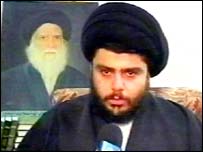
Iraq's Shi'ite leader claims he has formed a new government which will begin operating immediately.
Moqtada Sadr's announcement came at the end of a week of protests directed at the US-led coalition forces.
Sadr, who has rejected the country's US-instigated Governing Council, has created a list of ministries, although he has not named any ministers.
In other developments, a fire broke out on a pipeline in the Kirkuk oil fields in northeastern Iraq. Saboteurs have been blamed.
The country is said to be losing $7m a day through bomb damage to the main export pipeline to Turkey.
A Shi'ite warning to America
Asia Times -October 11
By Pepe Escobar
Muqtada is something of a working-class hero in Sadr City - the 2-million-strong Baghdad slum previously known as Saddam City. He claims to be thirtysomething, but some people in Baghdad estimate that he is not older than 28, and probably even younger. Even under Saddam's regime, his network was infiltrated by multiple intelligence services. Established clerics and Shi'ite intellectuals consider him a punk - not only because of his trademark sneer, but because he speaks colloquial rather than classical Arabic sprinkled with slang. Some Shi'ites even implicate him in the murders of his rivals Khoei and al-Hakim.
There are many reasons for Muqtada's widespread popularity, though. The main one is that he is the son of grand ayatollah Mohammed Sadiq al-Sadr, murdered by Saddam's regime in 1999. In addition, he delivers fiery speeches - widely available on video compact disc in Baghdad - against the occupiers: he derides the Governing Council as puppets; and he has nothing but contempt for the traditional Shi'ite religious leaders congregated at al-Hawza, which both Khoei and al-Hakim were. Muqtada insists that the marjaaiyya - the top Shi'ite clerics - have no popular base. His model is Ayatollah Kazim al-Husseini al-Haeri, an ultra-conservative Iraqi Shi'ite still based in Iran.
Immediately after the fall of Baghdad - with no Ba'ath Party structure and no security left in place - Muqtada acted with lightning speed to fill the power vacuum. From his base in Kufa, near Najaf, he dispatched the Muqtada faithful all over the Shi'ite south to set up neighborhood committees and take over local hospitals, collect garbage, protect warehouses, establish roadblocks to deter looters, protect electricity and water stations and transform Ba'ath Party offices into religious centers.
Muqtada commands a militia called the Jaysh al-Mahdi: on a recent religious holiday in Najaf, Asia Times Online experienced face-to-face its thuggish behavior. The militia is not nearly as well disciplined as the Badr Brigades. Both militias anyway remain infinitely more powerful than the badly equipped Iraqi police. Muqtada's acolytes and the Jaysh al Mahdi enforce a policy according to which no Iraqis may drink alcohol, and all Iraqi women should be veiled.
What they said about... the Rumsfeld-Rice rift
Guardian -Saturday October 11, 2003
...Tensions within the Bush administration over postwar Iraq were exposed this week after a major rift emerged between Donald Rumsfeld, the US defence secretary, and Condoleezza Rice, President George Bush's national security adviser.
On Monday Mr Bush announced a new body, the Iraq stabilisation group (ISG), led by Ms Rice, to oversee the rebuilding of Iraq. The following day Mr Rumsfeld, who was hitherto responsible for reconstruction, gave an interview to four European newspapers in which he said he had not been consulted and only learned of the new body after receiving a classified memo from Ms Rice. "I said I don't know. Isn't that clear? You don't understand English? I was not there for the backgrounding," he erupted after being pressed by a German reporter.
"Mr Rumsfeld is upset with the national security adviser... and he has shared his annoyance with the world," explained the New York Times, which put it down to "[his] being chastised for botching postwar Iraq".
The defence secretary had responded "with schnauzer-like testiness", reckoned Jim Hoagland in the New York Post, and identified it "as an acknowledgement that Mr Bush realises he has a huge problem with the way things are being reported and with how things are going in Iraq"...
|






 ]
]