|
|
 Home Home
|
Forums
Support  Shop News Shop News  Video Video  Audio Audio  Images Images  Help Help  Search Search  Members Members  Calendar Calendar
|
|
|
|
||
|
|||
 Deception Dollars  t-shirts Sections
911 Main
- About - My GFP - Older Stuff - Past Polls - Submit Story - BBS - Image Gallery - mp3 - SGTV
SGTV
911 Encyclopedia
Ewing2001 Has compiled a comprehensive list of links an articles pertaining to 911. This is required reading for anyone interested in understanding that horrid day ESPECIALLY since the presstitutes refuse to their job.
Mike Malloy pulls no punches with the FLYING MONKEY RIGHT. If you want to hear a REAL liberal tell it like it is don't miss his show! Listen Daily 9pm to 12pm One Year Later
Tune in to get a liberal helping of the TRUTH. Peter Werbe stands up to the neo-cons and for liberal cause daily while keeping us all informed on the daily events that are shaping our world. Listen Daily 2pm till 5pm
Liberal Talk Radio In Florida! Spread the word. Tell your friends to listen in. Call the station every Saturday and give them your supportive comments (239-732-9369). Call The Guy James Show live on the air (239-530-1660). The Randi Rhodes Show
Books
All Books
Greg Palast: Updated: with %40 more pages than the hard cover.
Alex Jones Video
Global Outlook
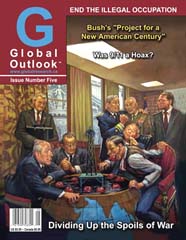
Michel Chossudovsky's Magazine on 911 and Post-911 Analysis Issue No.5-out now:Bush's "Project for a New American Century" Was 9/11 a Hoax? Diving up the Spoils of War Website Topics of the month: Was Kelly assassinated for "pulling the plug" The Forged Intelligence on Iraq Who's Who on the 9/11 "Independent" Commission Hot ranking thread: Counterpunch
GFP WiKi
|
Iraqgate UK: Former Intelligence Chief accused Blair of "credibility gap"posted by ewing2001 on Sunday July 06, @08:50AMfrom the Independent-UK dept. 
Intelligence chief accuses Blair of 'credibility gap' over WMDBy Paul Lashmar, Andy McSmith and James Morrison -Independent UK 06 July 2003
Iraq's missing weapons of mass destruction are opening a dangerous "credibility gap" between the Government and the public, a former intelligence chief has warned. The remarks by Dame Pauline Neville-Jones, former head of the joint intelligence committee, suggest that even if Downing Street wins its row with the BBC, questions about the origins of the Iraq war will remain unanswered.
Dame Pauline, who is also a BBC governor, suggested as long as coalition forces fail to uncover chemical, biological or nuclear weapons, questions will be asked about why troops were sent to war. "If you tell people you are going to war because there is an imminent threat to national security, and then in the aftermath nothing is found, it opens up a credibility gap of a kind which is dangerous in a democracy," she said in an interview with BBC News 24. "It is hard to sustain the thesis that Iraq was weaponised at operational readiness as we were led to believe." Other comments by Dame Pauline will reinforce the belief No 10 is winning its dispute with the BBC over its coverage of the controversy. A report by the Commons Foreign Affairs Select Committee tomorrow is expected to say it has found no evidence to support the BBC's claim that Downing Street officials tampered with intelligence reports to mislead the public over the scale of the threat. Other related articles: Former US Ambassador: "Administration appeared to have "twisted" Intelligence" NY Times -July 6, 2003 "...Criticism of the war and its aftermath was further fueled when a former United States diplomat said publicly that the Bush administration might willfully have ignored his conclusion, made on a C.I.A.-sponsored fact-finding trip to Niger, that Iraq almost surely did not seek uranium from that African country, despite administration claims that it had. The diplomat, Joseph Wilson, said that the administration appeared to have "twisted" intelligence to "exaggerate the Iraqi threat" by saying repeatedly that Baghdad had and was pursuing weapons of mass destruction. No such weapons have been found. His assertions, made in an opinion-page article in The New York Times, led to new Democratic criticism of the administration's use of intelligence. A senior Democratic senator said his staff would investigate the Niger matter. Prime Minister Tony Blair of Britain, and to a lesser extent President Bush, have faced angry accusations that they built their case for war partly on suspect intelligence. They have been accused, as well, of underestimating the challenges of pacifying and rebuilding the country after war. Former US Ambassador: "...we went to war under false pretenses"What I Didn't Find in Africa By JOSEPH C. WILSON NY Times -July 6, 2003
Did the Bush administration manipulate intelligence about Saddam Hussein's weapons programs to justify an invasion of Iraq? Based on my experience with the administration in the months leading up to the war, I have little choice but to conclude that some of the intelligence related to Iraq's nuclear weapons program was twisted to exaggerate the Iraqi threat. For 23 years, from 1976 to 1998, I was a career foreign service officer and ambassador. In 1990, as chargé d'affaires in Baghdad, I was the last American diplomat to meet with Saddam Hussein. (I was also a forceful advocate for his removal from Kuwait.) After Iraq, I was President George H. W. Bush's ambassador to Gabon and São Tomé and Príncipe; under President Bill Clinton, I helped direct Africa policy for the National Security Council. It was my experience in Africa that led me to play a small role in the effort to verify information about Africa's suspected link to Iraq's nonconventional weapons programs. Those news stories about that unnamed former envoy who went to Niger? That's me. In February 2002, I was informed by officials at the Central Intelligence Agency that Vice President Dick Cheney's office had questions about a particular intelligence report. While I never saw the report, I was told that it referred to a memorandum of agreement that documented the sale of uranium yellowcake — a form of lightly processed ore — by Niger to Iraq in the late 1990's. The agency officials asked if I would travel to Niger to check out the story so they could provide a response to the vice president's office. After consulting with the State Department's African Affairs Bureau (and through it with Barbro Owens-Kirkpatrick, the United States ambassador to Niger), I agreed to make the trip. The mission I undertook was discreet but by no means secret. While the C.I.A. paid my expenses (my time was offered pro bono), I made it abundantly clear to everyone I met that I was acting on behalf of the United States government. In late February 2002, I arrived in Niger's capital, Niamey, where I had been a diplomat in the mid-70's and visited as a National Security Council official in the late 90's. The city was much as I remembered it. Seasonal winds had clogged the air with dust and sand. Through the haze, I could see camel caravans crossing the Niger River (over the John F. Kennedy bridge), the setting sun behind them. Most people had wrapped scarves around their faces to protect against the grit, leaving only their eyes visible. The next morning, I met with Ambassador Owens-Kirkpatrick at the embassy. For reasons that are understandable, the embassy staff has always kept a close eye on Niger's uranium business. I was not surprised, then, when the ambassador told me that she knew about the allegations of uranium sales to Iraq — and that she felt she had already debunked them in her reports to Washington. Nevertheless, she and I agreed that my time would be best spent interviewing people who had been in government when the deal supposedly took place, which was before her arrival. I spent the next eight days drinking sweet mint tea and meeting with dozens of people: current government officials, former government officials, people associated with the country's uranium business. It did not take long to conclude that it was highly doubtful that any such transaction had ever taken place. Given the structure of the consortiums that operated the mines, it would be exceedingly difficult for Niger to transfer uranium to Iraq. Niger's uranium business consists of two mines, Somair and Cominak, which are run by French, Spanish, Japanese, German and Nigerian interests. If the government wanted to remove uranium from a mine, it would have to notify the consortium, which in turn is strictly monitored by the International Atomic Energy Agency. Moreover, because the two mines are closely regulated, quasi-governmental entities, selling uranium would require the approval of the minister of mines, the prime minister and probably the president. In short, there's simply too much oversight over too small an industry for a sale to have transpired. (As for the actual memorandum, I never saw it. But news accounts have pointed out that the documents had glaring errors — they were signed, for example, by officials who were no longer in government — and were probably forged. And then there's the fact that Niger formally denied the charges.) Before I left Niger, I briefed the ambassador on my findings, which were consistent with her own. I also shared my conclusions with members of her staff. In early March, I arrived in Washington and promptly provided a detailed briefing to the C.I.A. I later shared my conclusions with the State Department African Affairs Bureau. There was nothing secret or earth-shattering in my report, just as there was nothing secret about my trip. Though I did not file a written report, there should be at least four documents in United States government archives confirming my mission. The documents should include the ambassador's report of my debriefing in Niamey, a separate report written by the embassy staff, a C.I.A. report summing up my trip, and a specific answer from the agency to the office of the vice president (this may have been delivered orally). While I have not seen any of these reports, I have spent enough time in government to know that this is standard operating procedure. I thought the Niger matter was settled and went back to my life. (I did take part in the Iraq debate, arguing that a strict containment regime backed by the threat of force was preferable to an invasion.) In September 2002, however, Niger re-emerged. The British government published a "white paper" asserting that Saddam Hussein and his unconventional arms posed an immediate danger. As evidence, the report cited Iraq's attempts to purchase uranium from an African country. Then, in January, President Bush, citing the British dossier, repeated the charges about Iraqi efforts to buy uranium from Africa. The next day, I reminded a friend at the State Department of my trip and suggested that if the president had been referring to Niger, then his conclusion was not borne out by the facts as I understood them. He replied that perhaps the president was speaking about one of the other three African countries that produce uranium: Gabon, South Africa or Namibia. At the time, I accepted the explanation. I didn't know that in December, a month before the president's address, the State Department had published a fact sheet that mentioned the Niger case. Those are the facts surrounding my efforts. The vice president's office asked a serious question. I was asked to help formulate the answer. I did so, and I have every confidence that the answer I provided was circulated to the appropriate officials within our government. The question now is how that answer was or was not used by our political leadership. If my information was deemed inaccurate, I understand (though I would be very interested to know why). If, however, the information was ignored because it did not fit certain preconceptions about Iraq, then a legitimate argument can be made that we went to war under false pretenses. (It's worth remembering that in his March "Meet the Press" appearance, Mr. Cheney said that Saddam Hussein was "trying once again to produce nuclear weapons.") At a minimum, Congress, which authorized the use of military force at the president's behest, should want to know if the assertions about Iraq were warranted. I was convinced before the war that the threat of weapons of mass destruction in the hands of Saddam Hussein required a vigorous and sustained international response to disarm him. Iraq possessed and had used chemical weapons; it had an active biological weapons program and quite possibly a nuclear research program — all of which were in violation of United Nations resolutions. Having encountered Mr. Hussein and his thugs in the run-up to the Persian Gulf war of 1991, I was only too aware of the dangers he posed. But were these dangers the same ones the administration told us about? We have to find out. America's foreign policy depends on the sanctity of its information. For this reason, questioning the selective use of intelligence to justify the war in Iraq is neither idle sniping nor "revisionist history," as Mr. Bush has suggested. The act of war is the last option of a democracy, taken when there is a grave threat to our national security. More than 200 American soldiers have lost their lives in Iraq already. We have a duty to ensure that their sacrifice came for the right reasons. Joseph C. Wilson 4th, United States ambassador to Gabon from 1992 to 1995, is an international business consultant.
< US-Intelligence Professor Shultz: Saddam "destroyed weapons in 1990s" | BBC: New "Emergency Sessions" on Blair-BBC conflict >
|
Global Free Press Login
Related Links
| |||||
|
|||||||
|
[ home | contribute story | older articles | past polls | faq | authors | preferences ]
FAIR
USE NOTICE: This
site contains copyrighted material the use of which has not always been
specifically authorized by the copyright owner. We are making such material
available in our efforts to advance understanding of environmental, political,
human rights, economic, democracy, scientific, and social justice issues,
etc. We believe this constitutes a 'fair use' of any such copyrighted material
as provided for in section 107 of the US Copyright Law. In accordance with
Title 17 U.S.C. Section 107, the material on this site is distributed without
profit to those who have expressed a prior interest in receiving the included
information for research and educational purposes. For more information
go to: http://www.law.cornell.edu/uscode/17/107.shtml
If you wish to use copyrighted material from this site for purposes
of your own that go beyond 'fair use', you must obtain permission from the
copyright owner.
Powered by daVinci Interactive and Slashcode
 Add
GFP to your PALM via AvantGo
Add
GFP to your PALM via AvantGo
Add GFP HeadLines to your site XML
or RDF
Questions or Comments
Regarding This Site
webmaster@globalfreepress.com