Deception Dollars

t-shirts
Sections
Main
SGTV/INN

MUST SEE: 911 Documentry
Watch SGTV, our TV show, every Thursday on MNN webcast, 8 PM EST

Watch INN World Report, our new cooperation partner, every Friday (Repeats on Saturday + Sunday) on Free Speech TV, MNN and many other Public Access Channels, 6 PM EST.
INN is also our new breaking news partner. Their news shows incl. Interview Highlights with John Pilger, Joe Conason, Michael Meacher, Bev Harris, Cynthia McKinney, Sander Hicks and many others...
911 Encyclopedia
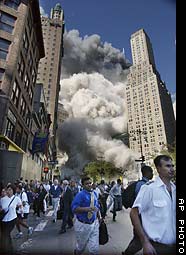
Ewing2001 Has compiled a comprehensive list of links an articles pertaining
to 911.
This is required reading for anyone interested in understanding that horrid
day ESPECIALLY since the presstitutes refuse to their job.
more...
 Search Search

9/11 News and GFP-911 Archive

Mike Malloy
Mike Malloy pulls no punches with the FLYING MONKEY RIGHT. If you want to
hear a REAL liberal tell it like it is don't miss his show!
Listen Daily 9pm
to 12pm
One Year Later

Peter Werbe
Tune in to get a liberal helping of the TRUTH. Peter Werbe stands up to the
neo-cons and for liberal cause daily while keeping us all informed on the daily
events that are shaping our world.
Listen Daily 2pm till 5pm

Liberal Talk Radio In Florida!
Spread the word. Tell your friends to listen in. Call
the station every Saturday and give them your supportive
comments (239-732-9369). Call The Guy James Show live
on the air (239-530-1660).
The Randi Rhodes Show

more...
Internet Radio/Tv For Progressives
Books
Alex Jones Video
Global Outlook

Michel Chossudovsky's Magazine on 911 and Post-911 Analysis
Issue No.5-out now:
Bush's "Project for a New American Century"
Was 9/11 a Hoax?
Diving up the Spoils of War
Website Topics of the month:
Was Kelly assassinated for "pulling the plug"
The Forged Intelligence on Iraq
Who's Who on the 9/11 "Independent" Commission
Hot ranking thread:
CIA closed friend with the finanzsystem of Al-Quida!
GLOBAL RESEARCH (CANADA) : FEATURE ARTICLES
25 November - 3 December 2003
Iraq: The Truth on the
Convoy which was attacked while driving through
Samara
The Rise of a New Dictatorship in Iraq , Firas Al-Atraqchi
The FTAA Protests: This is What Democracy Looks Like in Miami, Al Crespo
Enforcing Globalization: New World Order Weapons, John Valleau
Police State in America:
Bush’s Operation Clean Sweep: World War IV in
2004? John Stanton
Manipulating Pathologic Evidence: The David Kelly Story: Turning Murder
into Suicide, Rowena Thursby
The Legend of 9/11: Coincidence or Conspiracy: The Tale of The Millennial
Bomber, Chaim Kupferberg
Assassination of Reuters Cameraman, who had uncovered evidence of Mass US
Casualties in Iraq, Felicity Arbuthnot
Legal Scam in Denmark:
Danish government lawyers removed preconditions
for invasion of Iraq, Coilín Oscar ÓhAiseadha
Le Général Franks doute que la Constitution survive à une
attaque aux ADM
(armes de destruction massive) , John O. Edwards
Who’s Holding All the Cards?... The Bipartisan War Agenda, Michel
Chossudovsky & Ian Woods
Being "Against the War" is now a "Terrorist Act":
FBI
Targets Anti-War Activists
Counterpunch
|
(Open Headlines Popup Window)
posted by ewing2001
on Friday January 02, @07:37AM


from the Atimes/Pepe-Escobar dept.

Asia Times -December 25, 2003
AKU,
Azerbaijan - At an Eurasian economic summit in Almaty,
Kazakhstan, Gian Maria Gros-Pietro, chairman of Italy's
ENI, said that the Caspian held 7.8 billion barrels of
oil. Estimates from other sources run from 13 billion
tons to 22 billion tons to even 50 billion tons. For
Kazakhstan, officially they stand at 27.5 billion tons:
"If the forecasts are proved, in the nearest future the
oil of the Caspian region could make one fifth of the
world oil reserves and balance with the reserves of Iraq
and Kuwait together,"Gros-Pietro said.
Kazakhs
estimate that the Caspian already yields 4.7 million
barrels of oil a day. Saudi Arabia recovers 8.1 million
barrels a day and Russia 6.3 million. So the Caspian
would already be positioned in third place, ahead of
Iran at 3.4 million barrels and China at 2.8 million
barrels. New Azeri President Ilham Alyev, a former oil
executive, thinks that the Caspian could soon be in
second place, due to the combined reserves of
Azerbaijan, Turkmenistan and Kazakhstan .
Kazakhs are sure that the Caspian will become
the biggest source of oil, not only in the Commonwealth
of Independent States, the CIS, countries but in the
whole world. But many more pipelines are necessary to
fulfill the dream. For the moment, Caspian oil reaches
world markets via only five routes:
Baku-Novorossiysk,Baku-Supsa, Tengiz-Novorossiysk,
Atyrau-Samara and Neka-Tehran. The aggregate carrying
capacity of these pipelines in 2015 will be 122 million
tons - not counting the Baku-Tblisi-Ceyhan pipeline
(BTC) still under construction. But production in 2015
will be around 250 million to 300 million tons.
Pipelineistan has to grow exponentially.
Most
oil experts agree that the Caspian holds less than 10
percent of Middle East reserves. In fact, added
together, the rest of the world holds only around 53
percent of the proven reserves of the Middle East. But
according to a basket of energy forecasts, by 2050 the
Persian Gulf/Caspian Sea will account for more than 80
percent of world oil and natural gas production.
Together, the Persian Gulf and the Caspian may have
something like 800 billion barrels of oil and an energy
equivalent amount in natural gas. Compare this figure
with oil reserves in the Americas and in Europe: less
than 160 billion barrels. And they will be exhausted
before 2030.
Who owns what?
Iran
insists on an equal division of the Caspian sea - a
formula that would leave each of the five Caspian
countries with a 20 percent share. Azerbaijan,
Kazakhstan and Russia favor another mechanism in which
Iran would end up with roughly 13 percent. Nobody knows
exactly what Turkmenistan wants, given the total
unpredictability of President Saparmurat Niyazov.
Sharing the Caspian territory has been a
nightmare. But since last May, Azerbaijan, Kazakhstan
and Russia have in fact divided the northern Caspian.
Kazakhstan will control 29 percent, and Azerbaijan and
Russia 19 percent each. Iran and Azerbaijan still
haven't come to an agreement: they are wrangling over a
yet-to-be developed oilfield known as Alborz in Iran and
Alov in Azerbaijan. And both Iran and Turkmenistan are
disputing Azerbaijan's possession of three offshore
oilfields.
Andar Shukputov, the Kazakh
ambassador in Baku, says that both countries "share the
same position and are cooperating closely ... We believe
that every littoral state has sovereign rights to the
Caspian basin." He expects an "intelligent compromise",
and a "step-by-step approach to resolving the problems
of the Caspian's legal status after the seabed is
divided into national sectors".
Deals with
Turkmenistan are a huge problem because of the
impossible-to-fathom Nyazov. But Kazakh first vice
minister of foreign affairs Abuseitov Khuatovich says
that "Kazakhstan's proposal was completely supported by
Niyazov, president of Turkmenistan." Nevertheless, it's
still "necessary to determine the junction point of the
delimitation line of the Caspian floor's contiguous
parts, which is impossible without the participation of
Azerbaijan".
As for Azerbaijan-Russian problems,
they are intensifying even before the Baku-Tblisi-Ceyhan
pipeline, BTC, hits the market. A great BTC incentive
for Azeris is that the country will make more money.
Russia wants to double the volume of transit oil on the
Baku-Novorossiysk pipeline. Azerbaijan is against this
because it already stands to lose US$50 million in
2003-2004. Officials at Azerbaijan's state oil company
SOCAR in Baku say that the country produces 9 million
tons of oil a year: it exports only 2.5 million tons,
via Baku-Novorossiysk.
Compare this with the
so-called western pipeline - Baku-Supsa, in the Black
Sea, in Georgia. Tariffs of Baku-Novorossiysk, at $15.67
per ton, are five times more expensive than Baku-Supsa
($3 per ton). On top of it, high quality Azeri light oil
loses its price and value by being mixed with
low-quality Russian oil. Azeri officials say that if
that same high-quality oil was exported to the West, the
country would make an extra $50 to $100 million a year.
Russia plays rough. It has prevented LukOil -
the second-largest Russian oil firm - from participating
in the BTC. Azeri officials insist it is Russia which
"creates instability" in Georgia, through which the
pipeline will pass. They also say that when the BTC
starts operating, tariffs will also be around $3 per
ton. So the bulk of Azeri oil will be exported via BTC.
Russians are alarmed, and trying to secure a 10-year
guarantee that Baku oil will be exported through Russian
territory.
Russia's economy is heavily dependent
on oil and gas. This is an economy that "will grow 7
percent in 2003, or perhaps even more", according to
Russian Central Bank executive Oleg Vyugin. Yukos is
still in the lead among the Russian oil giants - in
spite of its mammoth legal, political and corporate mess
in 2003. The merger with rival Sibneft has collapsed.
Rates of production growth - for both Yukos and Sibneft
- are falling, while growing for LukOil. The key point
is that Russia cannot export more oil because its own
pipelines are technically in a sorry state. And there's
also great uncertainty about future oil prices.
The BTC bomb
The Baku-Tblisi-Ceyhan
pipeline, BTC, is being planned and built by the BTC
Pipeline Company (BTC Co), a huge consortium led and
operated by British oil giant British Petroleum, BP. The
major shareholders are BP (30.1 percent) and
Azerbaijan's state oil company SOCAR ( 25 percent). The
others are Unocal (US. Union Oil compay of California,
8.9 percent), Statoil (Norway, 8.71 percent), Turkish
Petroleum (6.53 percent), ENI (Italy, 5 percent),
TotalFinaElf (France, 5 percent), Itochu (Japan, 3.4
percent), ConocoPhillips (US, 2.5 percent), Inpex
(Japan, 2.5 percent) and Delta Hess (a joint venture of
Saudi Delta Oil with American Amerada, 2.36 percent). A
related South Caucasus gas pipeline (which would run
alongside the BTC), three oilfields
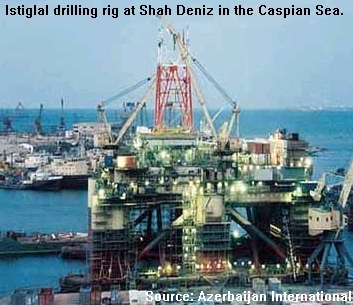
(Azeri-Chirag-Guneshli) and the Shah Deniz gasfield
which would feed the pipelines are also being planned by
the same consortium.
The three countries through
which the 1,767 kilometer pipeline will pass -
Azerbaijan, Georgia and Turkey - are all desperate to
finish the BTC on time. Turkey owes a fortune to the
International Monetary Fund. Georgia survives thanks to
American handouts. Azerbaijan courted international
lenders by setting up a state oil fund to use oil
revenues to the benefit of future generations.
Officially, the BTC will cost $2.95 billion, 30 percent
financed by the consortium and 70 percent borrowed. It
has already spiraled upwards to $3.7 billion, and
counting.
A British-based BTC campaign is
extremely concerned with the high stakes game around
BTC. It has stressed how BP extracted an international
treaty to back its investment. BTC is subject to an
Inter-Governmental Agreement (IGA) between Azerbaijan,
Georgia and Turkey - "but drafted by BP's lawyers", as
well as an individual Host Government Agreement (HGA)
between each of the three governments and the BP-led
consortium: "These agreements have largely exempted BP
and its partners from any laws in the three countries -
present or future - which conflict with the company's
project plans. The agreements allow BP to demand
compensation from the governments should any law
(including environmental, social or human rights law)
make the pipeline less profitable." The agreements have
for these reasons been described by non-governmental
organizations as "colonialist".
BTC's design is
a masterpiece of power politics, although it makes no
sense, as the most cost-effective route would be via
Iran. BTC slices Azerbaijan in half from east to west,
then slices Georgia in half almost from east to west
before taking a dip south, bypassing probably
secessionist Ajaria and slicing Anatolia diagonally from
the northeast towards the south. The BTC campaign points
out that "in the case of Turkey, the country would be
effectively divided into three: the area where Turkish
law applies; the Kurdish areas under official or de
facto military rule; and a strip running the entire
length of the country from north to south, where BP is
the effective government". These issues obviously do not
concern cheerful British BP employees downing their
pints at the Britannia pub at the Baku Hyatt.
The International Finance Corporation (IFC) -
the private sector arm of the World Bank - is the key
for financing BTC. It is now fully on board. But
opposition to BTC is also fully on board - from Kurdish
guerrillas in northeast Turkey to Georgia's Ministry of
Environmental Protection. Ankara has used emergency
powers to expropriate peasant land without decent
compensation. BTC may contain many potential breaches of
international law. And workers in Georgia are even
complaining that in the past few months their paychecks
have been sliced. During winter the salary of workers in
Georgia will be raised by only $2. About 3,000 Georgians
and 500 foreigners work on the BTC's Georgian stretch.
Executives of SOCAR, the Azeri state oil
company, in Baku say that an altered pipeline route
through Georgia would mean a new design, an extra
15-month delay and costs spiraling to as much as $5
billion. It doesn't matter that Georgian scientists have
warned that excavations for the pipeline construction
could result in the spread of acute infectious diseases
in Georgia. Some corporate assurances are frankly
Kafkaesque: among other justifications, BP in Baku says
that even in the case of an oil leakage in the Borjomi
area, there will be no damage to the source of the
famous local mineral water because the pipeline will be
15 kilometers away.
With Azerbaijan - and also
Kazakhstan - becoming important new energy suppliers for
the US, they are expected to be under heavy scrutiny. A
report by George Soros' Open Society Institute has
called for "accountability, transparency, and public
oversight in the oil and natural gas industries of
Azerbaijan and Kazakhstan". The report's opening
comments by Joseph Siglitz, Nobel laureate in economics
and former World Bank stalwart, may be just common
sense: "There is no issue of greater importance than
ensuring the long-run prosperity and stability of
resource-rich countries by developing ways to use these
resources and the wealth they generate well." These
words may not necessarily make corporate sense.
Chevron country
Kazakhstan is Chevron
country: the oil giant has invested more than $20
billion in these steppes. US National Security Adviser
Condoleezza Rice is Chevron's lady: from 1989 to 1992
she was on the board of directors as the resident
Kazakhstan expert.
Kazakhstan hopes to be
producing up to 250 million tons of oil by 2015. The
country has only two export routes: Tengiz-Novorossiysk
- 67 million tons maximum capacity - and Atyrau-Samara -
25 million tons maximum capacity after reconstruction -
both via Russia. Kazakhstan is now engaged in exporting
oil via modified Russian pipelines. A huge, 1,500
kilometer pipeline from the Caspian Sea to the Black Sea
port of Novorossyisk is the single largest American
investment in the Caspian. The main client will
inevitably be TengizChevroil, owned by Chevron (50
percent), ExxonMobil (25 percent) and Russian and Kazakh
partners (25 percent).
Kazakhstan's only outlet
to the Russian Transneft system is the Atyrau-Samara
pipeline. It's not enough. Kazakhstan desperately needs
new pipelines - because crumbling Russian infrastructure
restricts Kazakhstan producing and exporting more oil.
Kazakhstan also wants to export its oil to Europe
through the Odessa-Brody-Gdansk-Plock pipeline. Now it's
chasing the financing.
Russian executives
recognize the country has a capacity deficit of 40
million tons, which should drop to only 10 million tons
after a second Baltic Pipeline System (BPS) is in place.
So after carefully gaining Russia's "non-resistance",
Kazakhstan was finally able to sign a contract to link
Aktau to Baku and so join BTC. Russian companies could
even export their oil to the west via Aktau-Baku. Kazakh
President Nursultan Nazarbayev considers BTC an absolute
priority.
The feasibility project for a
Kazakhstan-Turkmenistan-Iran pipeline is also being
prepared, by French oil giant TotalFinaElf. And there's
the pipeline from Aktau to China, which should be
launched around 2010: it will only be justifiable in
case it delivers 20 million tons per annum. There have
been endless delays after a 1997 agreement between the
China National Petroleum Company (CNPC) and the Kazakh
energy ministry, but the political will is there and
both parties definitely want to do it.
Russia
and 'gas OPEC'
Turkmenistan holds 20 percent of
the world's natural gas reserves. But since April 2003,
90 percent of Turkmen gas exports are in fact under
control of Russian giant Gazprom. According to a 25-year
sweet deal, Gazprom pays $44 for every tonne, half in
cash and half in Russian goods, and then re-sells the
gas to Turkey for $150, and to Europe for $120. Under
another contract with Uzbekistan, Gazprom is getting
double the volume of Uzbek gas exports in exchange for
updating the local gas network. Russia is effectively on
its way to creating a "gas OPEC".
Trans-Afghan pipeline woes
The US is
also very much implicated in the resuscitation of the
Trans-Afghan gas pipeline, TAP - despite the endless
political mess in Afghanistan. Halliburton - after
making a killing in Iraq - would be expected to be on
board in Afghanistan. The Japanese-dominated Asian
Development Bank (ADB) is also very much interested.
Unocal still officially maintains that it has lost
interest in the Trans-Afghan gas pipeline it abandoned
in 1998. But it wouldn't say no to an oil pipeline
following the same route.
In a predictable move,
the Bush administration appointed its pet Afghan, oil
man Zalmay Khalilzad, as Washington's ambassador to
Kabul. Khalilzad, born in Mazar-i-Sharif in northern
Afghanistan but also pure University of Chicago
right-wing material, has already worked with grand chess
board master Zbigniew Brzezinski, former US national
security advisor, and under Pentagon number two Paul
Wolfowitz. It was Khalilzad - when he was a huge Taliban
fan - who conducted the risk analysis for Unocal (Union
Oil Company of California) for the infamous proposed $2
billion, 1,500 kilometer-long
Turkmenistan-Afghanistan-Pakistan,TAP, gas pipeline.
While Russian President Vladimir Putin has
demonstrated keen interest in an Eurasian gas alliance,
Turkmenistan's main concern is to free itself from
dependence on the Center Trunkline which connects the
whole Central Asian gas network to the Russian system.
Afghanistan's Hamid Karzai, for his part, needs money
from gas transit, and Pakistan President General Pervez
Musharraf needs to keep strategic ties with Afghanistan.
Once again, this is Pipelineistan as power politics. But
TAP may reveal itself to be a hugely impractical
proposition - basically because Afghanistan remains a
country at war. Nobody for the moment wants to invest in
TAP. Niyazov, Turkmenistan's unpredictable president,
even had to court Russian gas giant Gazprom, which
showed no interest. To top it all, nobody trusts
Niyazov. Gazprom calculated that importing Turkmen gas
is cheaper than developing remote Arctic and Siberian
fields. So it looks for the moment that Russia's gas
OPEC may be emerging as the winner.
The
Iranian factor
Iran is trading its own Persian
Gulf crude in return for Caspian oil from Russia and
Central Asia. The 300 kilometer-long Neka-Tehran
pipeline is raising Iran's swap capacity to 150,000
barrels a day. Swaps are attractive to both Iran and
Central Asia because transport costs are minimal. Iran
is feverishly working to position Neka-Tehran as a very
attractive and cheap route compared to BTC. A major
potential source of exports for Neka-Tehran is
Kazakhstan's huge Kashagan field, which is expected to
start pumping oil in 2007.
China in the
Caspian
China imports nearly 50 percent of its
oil, mostly from the Middle East. So inevitably, Central
Asia is becoming more crucial by the day. According to
China's Ministry of Finance, by 2010 the Middle Kingdom
will be importing 120 million tons of oil per year,
double what it imported in 2002. A pipeline from
Kazakhstan to western China is crucial, especially if
tapping from both Turkmenistan and Azerbaijan as well.
China will build a huge refinery in Urumqi, Xinjiang, to
import oil from Kazakhstan. Kazakh crude is crucial in
Beijing's strategy to pump oil from Western China to the
industrialized east coast.
No wonder the
highlight of Chinese President Hu Jintao's first foreign
trip as chief of state was a stop in Kazakhstan. China
National Petroleum Corp (CNPC) bought 25 percent of
CNPC-Aktobenumaygaz and discussions are in an advanced
stage concerning the China-Atasu-Alashankou oil
pipeline, as well as a gas link to Turkmenistan via
Kazakhstan.
As far as the Chinese are concerned,
the New Silk Road is already under way with the route
Urumqi-Alashankou-Druzhba-Aktau-Baku-Poti and further
down the road to the Caucasus, Eastern and Western
Europe. This is in fact the Traceca corridor, of which
Azerbaijan, Armenia, Bulgaria, Georgia, Kazakhstan,
Kyrgyzstan, Moldova, Romania, Tajikistan, Turkey,
Uzbekistan and Ukraine are members. The Azeri ferry from
Aktau to Baku, filled with railroad cars, is part of
that route, which speeds up cargo transport by 12 days
compared to Chinese cargo travelling via the Pacific
Ocean.
More than two years after September 11,
the Iraqi war has convinced quite a few Central Asian
governments that American economic and strategic plans
for the Caspian may not be in their best interest. China
is now also a major player - and adding leverage to
Central Asia in its relationship with the Americans.
China is already the biggest trading partner for most of
Central Asia. And Beijing is doing its best to tie
regional security to its Shanghai Cooperation
Organization.
Continue at Asia Times
< Christmas Terror "Suspect" was 5-year-old child
| U.S. bombs Baghdad, holds Reuters Staff near Falluja >
|
Global Free Press Login
Related Links
|

 Add
GFP to your PALM via AvantGo
Add
GFP to your PALM via AvantGo